
Key takeaways
- Compare the best scrub planes for fast stock removal with deeply cambered irons, wide mouths, and rugged bodies for rough dimensioning work.
What's inside
- How to Choose the Best Scrub Plane
- 1. Lie-Nielsen No. 40-1/2 Scrub Plane — The Premium Modern Pattern
- 2. E.C. Emmerich 106S Scrub Plane — The Traditional Wooden Scrub
- 3. Stanley No. 40 Scrub Plane — The Original
- 4. Sargent No. 160 Scrub Plane — The Solid Iron Roughing Plane
- 5. Sargent No. 161 Scrub Plane — The Wide-Body Pattern
- Comparison Table
- FAQ
- Verdict
As an Amazon Associate I earn from qualifying purchases. This post may contain affiliate links at no extra cost to you.
The scrub plane is the most single-minded tool in the hand plane family. It exists for one job: taking rough, twisted, over-thick stock down toward final dimension as fast as muscle power allows. Everything about the pattern serves that job. The sole is short, around nine and a half to ten inches, so the tool is light enough to push all day. The iron is narrow, thick, and ground with a deep curve — a radius of about three inches — so the center of the edge digs in and lifts a heavy, scalloped shaving while the corners stay clear of the wood. The mouth is opened wide so those thick shavings pass through instead of jamming. Worked diagonally across the grain, a scrub plane removes cup, twist and wind from a rough board faster than any other hand tool, and leaves a ridged surface that the fore plane and smoother then level and refine.
Disclosure: As an Amazon Associate, I earn from qualifying purchases. Product details were verified at the time of writing.
One honest note about this class before the picks: the dedicated scrub plane is a niche tool, and the current market is thin. Stanley stopped making the No. 40 in the early 1960s, and today’s new production comes from a short list of makers, several of whom sell direct rather than through marketplaces. The five planes below are the true scrub planes — narrow body, deeply cambered iron, wide-open mouth — that an Amazon buyer can actually order: one premium modern plane in the Stanley 40-1/2 pattern, one traditional German wooden scrub still in production, and three vintage American examples offered through a specialist tool dealer’s storefront. Vintage examples are individual tools, so condition follows the specific example listed; what does not vary is the pattern, and the pattern is what decides how a scrub plane works.
Contents
- How to Choose the Best Scrub Plane
- 1. Lie-Nielsen No. 40-1/2 Scrub Plane — The Premium Modern Pattern
- 2. E.C. Emmerich 106S Scrub Plane — The Traditional Wooden Scrub
- 3. Stanley No. 40 Scrub Plane — The Original
- 4. Sargent No. 160 Scrub Plane — The Solid Iron Roughing Plane
- 5. Sargent No. 161 Scrub Plane — The Wide-Body Pattern
- Comparison Table
- FAQ
- Verdict
How to Choose the Best Scrub Plane
Start with the iron, because the iron is the tool. A scrub plane lives or dies by its cutter. Look for a narrow iron — roughly 1-1/4 to 1-1/2 inches — ground with a pronounced curve across the edge, about a three inch radius. That curve is what lets the plane take a deep bite in the middle of the cut without the corners digging tracks into the surface. Thickness matters too: a stout iron, an eighth of an inch or better, resists flexing when the edge bites into reversing grain. A straight-ground bench plane iron does not belong in this class, and a plane sold with one is a conversion project, not a scrub plane.
Check the mouth. Scrub work produces the thickest shavings in hand planing, and they need somewhere to go. The throat of a true scrub is opened well up — on the classic metal patterns the frog sits far back and the mouth gap is a feature, not a flaw. If a plane’s mouth is tight enough for fine smoothing work, it will choke on scrub shavings and tear the surface instead of clearing it.
Understand how depth is set. Most scrub planes have no mechanical depth adjuster at all, and that is by design. On the metal patterns you loosen the lever cap, nudge the iron forward or back by hand, and sight down the sole to judge projection. On the wooden pattern the iron is tapped in with a mallet and backed out with a strike button. This sounds crude until you use it: scrub work is coarse work, the setting is judged by the shaving the plane takes, and there is nothing to clog, strip or knock out of true.
Weigh body material against the work. Cast iron bodies carry momentum and shrug off decades of shop abuse; the vintage American patterns below are effectively unkillable. A wooden body, the European tradition, is noticeably lighter and glides with less friction on resinous stock, which matters when you are scrubbing a whole stack of rough boards to thickness. Neither is better in the abstract — iron suits the worker who scrubs occasionally and hard, wood suits the worker who scrubs often and long.
Mind the handles. You push a scrub plane with your whole upper body, usually at a diagonal across the grain, so grip shape is working geometry, not decoration. The metal patterns use a rear tote and front knob in the Stanley manner. The wooden pattern uses a projecting front horn you wrap your leading hand around, which many workers find the most natural grip of all for heavy cuts. What you are checking is that the grip lets you drive the tool without your hands cramping over a long session.
Buy the pattern, then judge the example. For the vintage picks, the model number tells you the sole length, iron width and construction you are getting; the individual example in front of you tells you how much fettling stands between you and work. A scrub plane asks little: a sole free of deep damage, an iron with enough length left to grind the camber, and handles that are sound. Rust on the sides and tired japanning are cosmetic. A cracked casting or a broken tote is a walk-away.
1. Lie-Nielsen No. 40-1/2 Scrub Plane — The Premium Modern Pattern

Lie-Nielsen’s scrub plane is the Stanley 40-1/2 rebuilt to modern tolerances, and it is the benchmark the rest of the class is measured against. The body is ductile iron, fully stress relieved so it stays flat, with a manganese bronze cap. The blade is the heart of it: 1.450 inches wide and a full 3/16 inch thick, in A2 tool steel hardened to Rockwell 60-62, cryogenically treated and double tempered, and supplied ground to the correct three inch radius. At 10-1/4 inches long and 2.40 pounds it has the mass to keep a deep cut moving without the heft of a full bench plane, and the cherry knob and tote are shaped for a full grip. Depth is set the traditional way, by sighting down the sole, because that is all a scrub plane needs. The Amazon route to this plane is a specialist dealer’s example rather than the maker’s own storefront, so read the listing as the individual tool it is — but the tool itself is the finest scrub plane in current production.
Specs
- Sole length: 10-1/4 inches
- Blade: 1.450 inch wide x 3/16 inch thick, A2 tool steel
- Blade hardness: Rockwell 60-62, cryogenically treated
- Blade radius: 3 inches, ground by the maker
- Body: ductile iron, stress relieved
- Cap: manganese bronze
- Weight: 2.40 lb
- Handles: cherry knob and tote
2. E.C. Emmerich 106S Scrub Plane — The Traditional Wooden Scrub
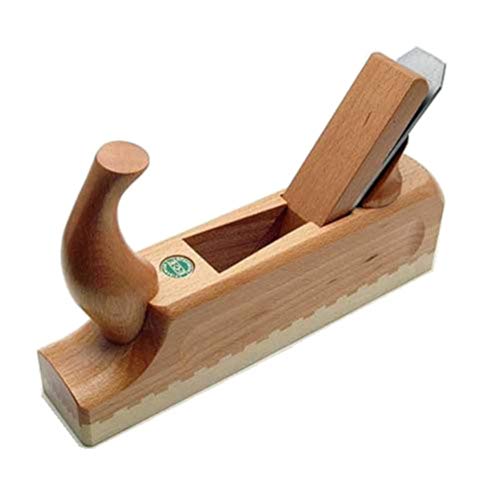
The ECE 106S is the European answer to the same problem, built the way German scrub planes have been built for generations: a wooden body you push by its front horn. The body is European beech with a hornbeam sole — hornbeam is the traditional choice because it wears slowly and slides easily — and the 33mm iron is held by a wooden wedge, with no chip breaker and no threaded adjustment anywhere on the tool. You set the cut by tapping the iron with a mallet and retract it by striking the button at the heel, a system that sounds primitive and in practice takes about a day to become second nature. At 240mm long the body is the classic scrub size, and the wooden construction keeps the weight down for long thicknessing sessions. This is the only plane in this guide in regular current production from its own maker, sold new through Amazon, and for a woodworker who dimensions rough stock by hand every week it is arguably the most practical pick here.
Specs
- Body length: 240mm (about 9-1/2 inches)
- Iron: 33mm (1-5/16 inch) wide
- Body: European beech
- Sole: hornbeam
- Adjustment: wedge-set iron, mallet taps and strike button
- Chip breaker: none, single-iron design
- Grip: front horn handle, traditional pattern
- Origin: made in Germany
3. Stanley No. 40 Scrub Plane — The Original
Every metal scrub plane descends from this one. Stanley introduced the No. 40 in 1896 and kept it in the catalog until 1962, and across that long run the pattern barely changed, because there was little to improve: a 9-1/2 inch cast iron body with a japanned finish, a narrow 1-1/4 inch iron ground with the deep camber the work demands, a wide-open mouth, and a wooden knob and tote. There is no depth adjuster; you set the iron by eye against the sole and let the shaving tell you the rest. The No. 40 is a light tool by design — Stanley built it to be pushed fast and long without wearing the worker out — and generations of carpenters used it as a hand-fed thicknesser on stock too wide or too rough for the machines of the day. The examples on Amazon come through a specialist vintage tool dealer, so each listing is one specific plane with its own history; check the iron length and the tote, and a sound example will outwork most tools in a modern shop.
Specs
- Sole length: 9-1/2 inches
- Iron: 1-1/4 inch wide, deeply cambered
- Body: cast iron, japanned finish
- Adjustment: manual, iron set by sighting down the sole
- Handles: wooden knob and tote
- Production years: 1896 to 1962
- Status: vintage example, condition per listing
4. Sargent No. 160 Scrub Plane — The Solid Iron Roughing Plane
Sargent of New Haven was Stanley’s great American rival, and the No. 160 was its roughing plane. The first pattern, the one in this listing, is the most distinctive scrub ever cast in America: the body is a single solid piece of cast iron, handle and all, a tool with nothing to loosen, crack or work free. Catalog data gives the plane at ten inches long with a narrow iron of about one inch — the narrowest cutter in this guide — which concentrates the push behind a small edge and makes the 160 a notably willing cutter in stubborn, twisted stock. Sargent replaced it in 1928 with a second pattern in cast iron with mahogany handle and knob, but collectors and users alike hunt the solid iron version for its sheer indestructibility. As with the other vintage picks here, the Amazon listing is an individual example through a specialist dealer; the pattern itself is as rugged as hand tools get.
Specs
- Length: 10 inches
- Cutter: about 1 inch wide, cambered
- Body: solid cast iron, one-piece first pattern
- Handles: integral with the casting on the first pattern
- Maker: Sargent & Co., New Haven, Connecticut
- Later pattern: cast iron with mahogany handle and knob, from 1928
- Status: vintage example, condition per listing
5. Sargent No. 161 Scrub Plane — The Wide-Body Pattern
The No. 161, patented in 1914, is Sargent’s second scrub pattern and a different animal from the 160: a wide body carrying a 1-1/2 inch iron, the widest cutter in this guide. The construction is the same one-piece philosophy — the body is a solid casting that includes the handle and knob — so there are no wooden parts to split under the mallet work of setting the iron. That wide iron, ground with the deep radius scrub work needs, takes the broadest scalloped shaving of any plane here, which makes the 161 the fastest of the vintage picks across a wide, rough panel, with a harder push per pass as the trade. It is the least common of the three vintage patterns in this guide, and the dealer’s example listed on Amazon is presented as a clean, fine tool with no issues. For a worker who wants one vintage scrub and wants it to move the most wood per stroke, this is the pattern to chase.
Specs
- Iron: 1-1/2 inch wide, cambered
- Body: solid cast iron, one-piece casting
- Handles: integral with the casting
- Pattern: wide body
- Patent: 1914
- Maker: Sargent & Co., New Haven, Connecticut
- Status: vintage example, condition per listing
Comparison Table
| Plane | Sole length | Iron | Body | Adjustment | Weight |
|---|---|---|---|---|---|
| Lie-Nielsen No. 40-1/2 | 10-1/4 in | 1.450 in x 3/16 in, A2 steel | Ductile iron | Manual, sighted down the sole | 2.40 lb |
| E.C. Emmerich 106S | 240mm (9-1/2 in) | 33mm | Beech with hornbeam sole | Wedge and strike button | Not published |
| Stanley No. 40 | 9-1/2 in | 1-1/4 in | Cast iron, japanned | Manual, sighted down the sole | Not published |
| Sargent No. 160 | 10 in | About 1 in | Solid cast iron, one piece | Manual, sighted down the sole | Not published |
| Sargent No. 161 | Wide body pattern | 1-1/2 in | Solid cast iron, one piece | Manual, sighted down the sole | Not published |
FAQ
What is the difference between a scrub plane and a jack plane with a cambered iron?
They do similar work at different intensities. A jack plane is a 14 inch general-purpose tool; fitted with a cambered spare iron it can rough stock respectably, and many shops work exactly that way. A scrub plane is shorter, lighter, narrower in the iron and far more deeply cambered, with a mouth opened much wider, so it takes a heavier shaving with less effort and clears the chip without jamming. The scrub is the specialist: faster at pure stock removal, useless for anything finer. The jack is the compromise: slower at scrubbing, capable of everything else.
How deep a cut does a scrub plane take?
Far deeper than any other bench plane. A scrub is commonly set to lift a shaving a thirty-second of an inch thick or more at the center of the cut, worked diagonally across the grain so the ridged surface it leaves can be read at a glance: high spots show as long ridges, low spots stay untouched until the plane reaches them. The exact setting is judged by the shaving, not by a number, which is why the pattern does without a depth adjuster.
How do you sharpen a scrub plane iron?
Grind and hone the curve, not a straight edge. The edge carries a radius of about three inches, maintained by rolling the iron across the stone as you work so the whole arc stays evenly sharp. The curve does not need to be a perfect geometric radius — it needs to be smooth, symmetrical enough that neither corner digs, and sharp from side to side. A wire edge is removed by stoning the back flat, exactly as with any other plane iron.
Can a scrub plane replace a powered thickness planer?
For the widths that matter, it already did for centuries. A scrub plane has no width limit, no snipe, and no minimum thickness it struggles with, and on a single board or a small batch it is genuinely quick: knock off the high spots diagonally, check with winding sticks, and hand the board to the fore plane. What it cannot match is a machine’s pace across a whole lumber order. Most hand-tool shops scrub the worst twist and cup out first, then decide how the board gets to final thickness.
What should I check on a vintage scrub plane before buying?
Three things decide a vintage example. The iron needs enough length left to hold the camber — a plane whose iron has been ground nearly to the slot is a project, not a user. The casting needs to be free of cracks, especially around the mouth and the handle roots on the one-piece Sargent patterns. And the sole should be free of deep pitting where it meets the wood. Tired japanning, surface rust and dull handles are cosmetic, and on a tool built for the roughest work in the shop they matter least of all.
Verdict
For a buyer who wants the best scrub plane in current production and is content to take it through a dealer’s listing, the Lie-Nielsen No. 40-1/2 stands alone: ductile iron body, bronze cap, and a thick A2 blade ground to the correct radius by the maker. The E.C. Emmerich 106S is the practical traditionalist’s pick — a new, wooden, horn-grip scrub that is light in the hands and still made the way it has been made for generations. The Stanley No. 40 remains the pattern that started it all, and a sound example is still a superb working tool. The two Sargents split the vintage difference: the solid iron No. 160 for the narrowest, most willing cut, and the wide-body No. 161 for the broadest shaving of the group. Whichever pattern lands on your bench, grind the camber deep, open the mouth wide, and work diagonally — that is the whole craft of the scrub plane.
Related guides
More from Amazon
Programs that pair well with the guide above. Offers and eligibility are set by Amazon and may change.
A free business account with business pricing and bulk-buying tools for work, shop or home office.
Create a business accountFree shipping on eligible items, Prime Video and more. Eligible new members can start with a free trial.
Start a Prime free trialAudiobooks and podcasts to listen to on the go. Eligible new members can start with a free trial.
Try Audible freeAd-free music streaming. Eligible new subscribers can start with a free trial.
Try Music Unlimited freeAs an Amazon Associate we earn from qualifying purchases.








