
Our Top Picks

What's inside
As an Amazon Associate I earn from qualifying purchases. This post may contain affiliate links at no extra cost to you.
A plasma cutter turns compressed air and an electric arc into a jet hot enough to melt through steel, stainless, aluminum, and copper, then blows the molten metal out of the cut. Compared with an angle grinder it is faster, quieter about the ears, and leaves a narrow kerf with far less cleanup; compared with an oxy-fuel torch it starts instantly, runs on shop air and electricity alone, and cuts non-ferrous metals a flame cannot touch. That is why a handheld inverter plasma cutter has become standard kit in fabrication shops, farm workshops, and serious home garages: trailer frames, patch panels, brackets, gates, and plate all part cleanly in one pass.
The five machines below are all handheld inverter cutters, and they spread across the useful range of the class. Output runs from 40 amps on the premium-brand Hobart to 85 amps on the SILATU, and every one of them runs on dual voltage, so the same box works from a household outlet today and a heavier shop circuit tomorrow. The real differences are cut capacity, arc start type, duty cycle, and whether the machine is built for hand cutting only or can also drive a CNC table later. A note on scope: gantry cutting tables and CNC plasma systems are a different class of equipment, and this guide covers the handheld machines themselves.
Disclosure: As an Amazon Associate, I earn from qualifying purchases. Product details were verified at the time of writing.
Contents
How to Choose a Plasma Cutter
Match output to the thickest metal you cut regularly. Amperage drives everything. As a working guide, a 40A machine clean-cuts steel around 3/8 to 5/8 inch, a 50A machine handles 1/2 inch plate all day, and 60A and above opens up 5/8 inch and thicker work. Buy for the thickest stock on your regular job list, not the one thick piece you might meet once a year — the severance figure covers that piece, slowly.
Read clean cut and severance as two different numbers. The clean cut figure is the thickness that parts with a smooth, usable edge at a reasonable travel speed. The severance figure is the thickest metal the arc will separate at all, with a rough edge, slow travel, and grinding afterward. Makers headline whichever number is bigger, so compare clean cut against clean cut when you line models up side by side. Both figures drop on lower input voltage, and both are stated for mild steel; expect a step down on stainless and aluminum.
Choose the arc start for your metal and your shop. A touch start strikes the arc when the tip meets the work: simple and proven, but it wants a clean starting edge and struggles on expanded metal. A pilot arc lights a small arc inside the torch first, so cutting starts without contact and keeps running across paint, rust, and perforated sheet — the better choice for salvage and repair work. Within pilot arc machines, non-high-frequency blowback starts matter if you run CNC electronics or other sensitive gear nearby, because a high-frequency start can interfere with them.
Understand what dual voltage really gives you. Every machine here accepts both household and shop voltage, but full output only arrives on the higher voltage. On a household circuit the same cutter may deliver little more than half its maximum amperage, with clean cut capacity shrinking in step. Dual voltage is about flexibility — light work anywhere, full work where the heavy circuit lives — not about getting full power from a thin outlet. Check the breaker size the maker specifies for each voltage before the machine arrives.
Read the duty cycle as working time. Duty cycle is the share of a ten-minute window the machine can cut at a stated output before it must cool. A figure of 60% at full output means six minutes of arc time in ten, which suits most hand cutting because layout, clamping, and moving the work fill the gaps. Long straight cuts in thick plate are where a low duty cycle shows up, as a thermal shutdown mid-cut.
Budget for air, because no cutter here includes a compressor. Plasma cutting consumes a steady stream of dry compressed air, and each model states a pressure in PSI and a flow in CFM. Your compressor must hold that flow at that pressure for the length of a cut, not just reach it on the gauge. Moisture is the enemy of consumable life, so plan on a filter or dryer between the compressor and the torch, and keep spare tips and electrodes for the torch family your machine uses — IPT40, AG60, PT31, and brand torches like the Hobart XT40R each take their own consumables.
Decide about CNC before you buy. A handheld cutter with CNC ports and a non-HF start can move onto a gantry table later and follow programmed paths. If a table is even a distant plan, choose a machine with the ports and the 1:1 arc voltage output a table controller wants. If the cutter will live its whole life in your hand, those ports are dead weight and the money is better spent on output and duty cycle.
Take safety as part of the setup. The arc demands a proper shade lens, the jet throws molten metal, and galvanized or coated stock gives off fumes you do not want to breathe. Work with ventilation, keep the area clear of anything that burns, and wear the gloves and eye protection the manual calls for.
The 5 Best Plasma Cutters
1. LOTOS LT5000D 50A Plasma Cutter
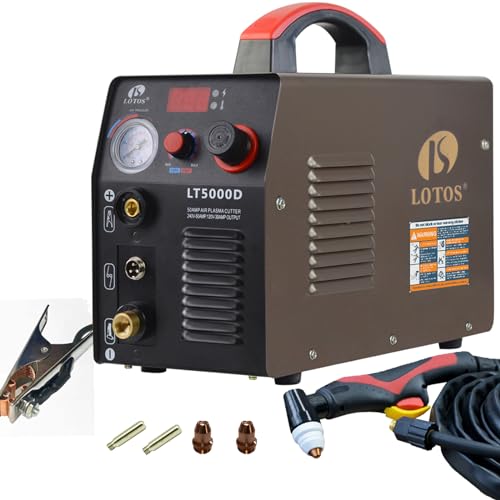
The LT5000D is the machine that put this class within reach of home shops, and the current version keeps the formula: 50 amps of DC output, dual voltage input, and a clean cut figure of 5/8 inch (16 mm) in mild steel with severance to 3/4 inch (20 mm). That clean cut number is strong for a 50A machine and covers the bulk of real work — flat bar, angle, trailer steel, and plate up to half an inch without strain. The duty cycle is 60% at the full 50 amps, so long cuts in heavier stock do not end in a thermal pause every couple of minutes. It starts its arc at the tip rather than with a non-touch pilot arc, so it prefers a clean edge to strike on and asks for a retrigger across expanded metal; on solid stock, which is most work, that never comes up. If you want one proven cutter for general steel work and your stock is mostly clean, this remains the straightforward pick.
Specs
- Output: 50A DC
- Input: Dual voltage, 120V or 240V
- Clean cut: 5/8 in (16 mm) mild steel
- Severance cut: 3/4 in (20 mm)
- Duty cycle: 60% at 50A
- Arc start: Touch start
- Metals: Steel, stainless, aluminum, copper
2. YESWELDER CUT-65DS PLUS 65A Plasma Cutter
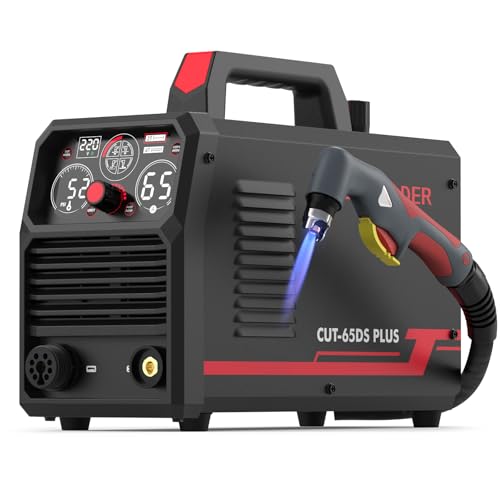
The CUT-65DS PLUS is the most versatile machine in this group. Its 65 amps arrive with a non-touch pilot arc on an IPT40 torch and a non-high-frequency blowback start, so it lights on painted and rusty metal without spraying interference into nearby electronics. Output runs 20 to 65 amps on 220V and 20 to 45 amps on 110V, with a duty cycle of 60% at the full 65 amps. The maker’s manual gives an ideal clean cut of 9/16 inch (14 mm) at 220V and 5/16 inch (8 mm) at 110V, with maximum cuts of 1 inch (25 mm) and 5/8 inch (16 mm) at those voltages. What sets it apart is the mode dial: beyond plate cutting it adds grid cutting for expanded metal, gouging for weld removal, and a marking mode, four jobs in one box. A large digital display shows settings at a glance, post-flow time adjusts from 10 to 90 seconds to cool the torch, and the machine carries an IP21S protection class with ETL certification stated on the listing. Shops that cut, gouge, and mark with one machine will get the most from it.
Specs
- Output: 65A max (20-65A on 220V, 20-45A on 110V)
- Input: Dual voltage, 110V or 220V
- Clean cut: 9/16 in (14 mm) at 220V, 5/16 in (8 mm) at 110V
- Maximum cut: 1 in (25 mm) at 220V, 5/8 in (16 mm) at 110V
- Duty cycle: 60% at 65A
- Arc start: Non-touch pilot arc, non-HF blowback, IPT40 torch
- Modes: Plate cutting, grid cutting, gouging, marking
- Air: 45-75 PSI, about 6 CFM
- Protection: IP21S, ETL certified per listing
3. bestarc BTC500DP 50A Plasma Cutter

The BTC500DP is the beginner-friendly face of the 50A class, built around a large LED display that shows cutting current, voltage, and — through a built-in air sensor — the air pressure at the machine, so a new operator can see the setup instead of guessing at it. Output is 50 amps on dual voltage, with a clean cut of 1/2 inch and a maximum cut of 20 mm at 220V on 65 PSI of air; on 110V the maximum figure is 12 mm. The maker lists a pilot arc function for starting without dragging the tip, and the controls offer 2T and 4T trigger modes, so a long cut can run latched instead of held, plus post-flow cooling and a mesh mode for perforated stock. Fault codes on the display help track down a bad ground or worn consumable. None of that changes the physics — it is a 50A cutter with 50A capacity — but the readouts shorten the learning curve more than any other machine here, which is exactly what a first plasma cutter should do.
Specs
- Output: 50A
- Input: Dual voltage, 110V or 220V
- Clean cut: 1/2 in
- Maximum cut: 20 mm at 220V (65 PSI air), 12 mm at 110V (50 PSI air)
- Arc start: Pilot arc (maker listing)
- Display: Large LED with air pressure sensor readout
- Trigger modes: 2T and 4T, with post-flow cooling
- Weight: 20.9 lb (9.48 kg)
4. SILATU STC850P MAX 85A Plasma Cutter
The STC850P MAX is the heavy end of this lineup, an 85-amp machine for shops whose work has outgrown the 50A class. On 220V it cuts material up to 35 mm thick; on 110V, at 40 amps, it still manages 15 mm, which is more than many 50A machines claim on full power. The duty cycle is 60%, the start is a non-high-frequency blowback pilot arc, and an air sensor puts pressure on the front panel display. What makes this one different is the CNC readiness: it carries 2-pin and 5-pin CNC ports with a 1:1 arc voltage output, so the same machine that cuts by hand today can hang under a gantry table tomorrow, and the non-HF start keeps the table’s electronics out of trouble. At 23.15 pounds it is the heaviest cutter here and wants a fixed spot in the shop rather than a life in a carry case. The maker states a 1-year warranty. If your plate work runs thick, or a CNC table is on the roadmap, this is the machine in the group built for it.
Specs
- Output: 85A on 220V, 40A on 110V
- Input: Dual voltage, 110V or 220V
- Maximum cut: 35 mm at 220V, 15 mm at 110V
- Duty cycle: 60%
- Arc start: Non-HF blowback pilot arc
- CNC: 2-pin and 5-pin ports, 1:1 arc voltage output
- Air: About 60 PSI on 110V, 70 PSI on 220V, about 250 L/min flow
- Display: LED screen with air sensor
- Weight: 23.15 lb
- Warranty: 1 year (maker stated)
5. Hobart AirForce 40i Plasma Cutter

The AirForce 40i is the premium-brand pick, and its numbers explain the different philosophy: 40 amps maximum, but delivered with the documentation and support structure of a major welding brand. On 240V it puts out 40 amps at a 60% duty cycle; on a 120V circuit it gives 20 amps at 60% on a 15-amp breaker, or 27 amps at 35% on a 20-amp breaker. Hobart states a clean cut of 5/8 inch (15.9 mm) in mild steel and a maximum cut of 7/8 inch (22 mm) — a 40A machine matching the clean cut of bigger-output rivals, because output figures and cutting figures are not the same thing. The XT40R torch runs 12 feet, a pilot arc controller keeps the arc alive across expanded and perforated metal without retriggering, and tool-less MVP adapters swap between 120V and 240V plugs. At 21 pounds with a shoulder strap it is built to move between jobs. The backing is the point: a 5/3/1 warranty structure (five years on transformers and main rectifiers, three on boards and drive systems, one on the torch), CSA certification, and a dealer network that stocks the consumables. Buyers who value support over headline amperage will land here.
Specs
- Output: 40A max (20-40A)
- Input: 120V or 240V with MVP tool-less adapters
- Output by input: 40A at 60% duty cycle on 240V; 20A at 60% or 27A at 35% on 120V
- Clean cut: 5/8 in (15.9 mm) mild steel
- Maximum cut: 7/8 in (22 mm)
- Arc start: Pilot arc controller
- Torch: XT40R, 12 ft lead
- Air: 6.0 CFM at 90-120 PSI
- Weight: 21 lb (9.5 kg)
- Warranty: 5/3/1 structure (maker stated)
- Certification: CSA
Comparison Table
| Model | Output | Input | Clean cut | Max / severance cut | Duty cycle | Arc start |
|---|---|---|---|---|---|---|
| LOTOS LT5000D | 50A | 120V / 240V | 5/8 in | 3/4 in | 60% at 50A | Touch start |
| YESWELDER CUT-65DS PLUS | 65A | 110V / 220V | 9/16 in at 220V | 1 in at 220V | 60% at 65A | Non-touch pilot arc, non-HF |
| bestarc BTC500DP | 50A | 110V / 220V | 1/2 in | 20 mm at 220V | See listing | Pilot arc |
| SILATU STC850P MAX | 85A | 110V / 220V | See listing | 35 mm at 220V | 60% | Non-HF blowback pilot arc |
| Hobart AirForce 40i | 40A | 120V / 240V | 5/8 in | 7/8 in | 60% at 40A on 240V | Pilot arc controller |
Frequently Asked Questions
What size plasma cutter do I need for 1/2 inch steel?
A 50A machine is the comfortable answer: every 50A pick in this guide clean-cuts 1/2 inch mild steel, and the 65A and 85A machines take it with headroom to spare. A 40A machine with a strong clean cut figure, like the Hobart, also covers 1/2 inch, but with less travel speed in hand. Size for clean cut, not severance.
Do I need a separate air compressor?
Yes. None of these machines includes one. Match the compressor to the cutter’s stated flow and pressure — roughly 5 to 6 CFM at 60 to 90 PSI covers this group — and make sure it can hold that flow for a full cut, not just reach it. Add a filter or dryer, because wet air eats tips and electrodes.
What is a pilot arc, and do I need one?
A pilot arc starts a small arc inside the torch before the main cutting arc transfers, so you can begin a cut without touching the tip to the metal and keep cutting across paint, rust, and the holes in expanded metal. For fabrication on clean new steel it is a convenience; for repair work on dirty or perforated stock it is close to a necessity.
Can a plasma cutter cut aluminum and stainless steel?
Yes. Plasma cuts any electrically conductive metal, and every machine here is listed for steel, stainless, aluminum, and copper. Expect the practical thickness to step down from the mild steel figures on stainless and aluminum, and use the ventilation you would use for any coated metal, because the fumes are the real hazard.
Can I run one of these on a CNC table later?
Only if the machine is built for it. Look for CNC ports and a non-high-frequency start, which in this group means the SILATU STC850P MAX. High-frequency starts can disturb table electronics, and a cutter without ports gives the controller nothing to talk to. The others are hand cutters and should be bought as hand cutters.
Verdict
Match the machine to the work and the choice makes itself. The LOTOS LT5000D is the proven 50A workhorse for general steel cutting. The YESWELDER CUT-65DS PLUS adds a pilot arc, 65 amps, and gouging, grid, and marking modes for shops that do more than slice plate. The bestarc BTC500DP wraps the same 50A class in a display and air sensor that teach a beginner what the machine is doing. The SILATU STC850P MAX is the pick for thick plate today and a CNC table tomorrow. And the Hobart AirForce 40i trades headline amperage for brand backing and a warranty structure the others do not match. The right one is the one whose figures line up with your thickest regular job and the circuit you actually have.
Related guides
More from Amazon
Programs that pair well with the guide above. Offers and eligibility are set by Amazon and may change.
A free business account with business pricing and bulk-buying tools for work, shop or home office.
Create a business accountFree shipping on eligible items, Prime Video and more. Eligible new members can start with a free trial.
Start a Prime free trialAudiobooks and podcasts to listen to on the go. Eligible new members can start with a free trial.
Try Audible freeAd-free music streaming. Eligible new subscribers can start with a free trial.
Try Music Unlimited freeAs an Amazon Associate we earn from qualifying purchases.








