
Key takeaways
- Compare the best thread mills by thread pitch range, cutter diameter, flute style and coating, for CNC milling of internal and external threads in metal.
As an Amazon Associate I earn from qualifying purchases. This post may contain affiliate links at no extra cost to you.
A tap is a gamble in an expensive part: if it snaps in the hole, the part often goes in the scrap bin with it. A thread mill takes the risk out of the cut. Instead of forcing a full-size thread form through the metal in one motion, a small carbide cutter interpolates the thread helix under CNC control, taking the profile in light passes. The same tool cuts internal and external threads, right-hand and left-hand, and a broken cutter lifts straight out of the hole instead of wedging in it. For shops that thread blind holes, thin walls, or hard alloys, that control is the whole argument.
Disclosure: As an Amazon Associate, I earn from qualifying purchases. Product details were verified at the time of writing.
The five thread mills below cover the forms a small CNC shop meets most often: UN inch threads, ISO metric threads, tapered NPT pipe threads, and NPTF dryseal pipe threads, in cutter sizes from fine work up to 3/4 inch pipe and bolt sizes.
How to Choose a Thread Mill
Start with the thread form. Thread mills are ground to one form: UN (the UNC/UNF inch series), ISO metric, or a tapered pipe form such as NPT or NPTF. The form ground into the cutter has to match the thread being cut; a UN mill cannot produce a metric profile, and a straight-form mill cannot produce a proper taper pipe thread. Pipe forms add a wrinkle worth knowing: NPT and NPTF share the same 1 degree 47 minute taper, but NPTF dryseal threads are ground to tighter crest and root tolerances so the joint seals without dope or tape doing the sealing work.
Decide between single-profile and multi-form cutters. A single-profile (single-point style) mill carries one thread tooth, so one tool cuts any diameter of a given pitch — flexible, and kind to small machines, but it needs many helical passes to build a full thread depth. A multi-form mill carries a stack of teeth ground to one pitch, so it finishes the full thread form in roughly one pass per depth step. Multi-form is far faster and is what most production shops run; single-profile earns its place for odd pitches, very small bores, and one-off work where buying a dedicated mill per pitch makes no sense.
Check the cutter diameter against the minor diameter. For an internal thread, the cutter has to pass through the drilled tap hole with room to orbit, so its diameter must sit comfortably under the thread’s minor diameter. Makers publish the cutter diameter for every model; match it to the hole before anything else. For external threads the constraint flips — the cutter needs enough reach and tooth height to cover the major diameter, which is rarely the limiting factor.
Pick the flute style for the material and the machine. Helical flutes shear the chip and spread the cutting load, which keeps finish smooth in steels and stainless and reduces chatter on lighter machines. Straight-flute mills are stiffer and simpler, and they behave well in cast iron and short-chipping metals. Flute count follows size: small mills often run 3 or 4 flutes, and more flutes mean a stronger core at a given diameter but less chip room in gummy alloys.
Match the coating to the workpiece. AlTiN-coated carbide handles the heat of threading alloy steels, stainless, and cast iron, and it holds an edge through long runs. Bright uncoated carbide is the sharper edge out of the box and is the traditional choice for aluminum and brass, where a polished flute sheds built-up edge. Plain carbide with no coating sits between the two and is a sound general-purpose pick.
Confirm the machine can run the cycle. Thread milling needs a control that supports helical interpolation — simultaneous motion in X, Y, and Z. Nearly every CNC mill built in the last few decades does, but the holder matters too: runout at the cutter shows up directly in thread fit, so a good collet chuck or shrink-fit holder earns its keep here. Check shank diameter against the holders on hand before ordering.
The 5 Best Thread Mills
1. Titan TC84019 Solid Carbide Thread Mill, 3/8-16 UN — Best UN Pick
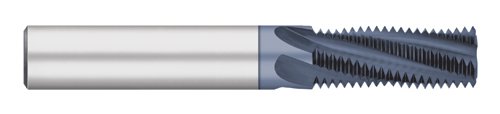
Titan USA grinds this multi-form mill for the single most common inch thread in small-shop work: 3/8-16 UNC. The 0.290 inch cutter diameter slips into a standard 5/16 inch tap drill hole with room to interpolate, and the 0.750 inch thread length covers through holes and blind holes in plate up to 3/4 inch thick. Four helical flutes in solid carbide, finished with an AlTiN coating, give it the edge life for alloy steel and stainless work where an uncoated tool dulls quickly. Because the form is ground for both internal and external cutting, the same mill threads a stud and the hole it screws into. The 5/16 inch shank fits the collet sets most benchtop and knee-mill CNC conversions already carry.
Specs:
– Thread form: UN (UNC/UNF profile), internal and external
– Thread size: 3/8-16 (16 TPI pitch)
– Cutter diameter: 0.290 in
– Flute style: Multi-form, helical flute
– Flutes: 4
– Thread length: 0.750 in
– Shank: 5/16 in
– Overall length: 3 in
– Material/coating: Solid carbide, AlTiN coated
2. Titan TC84636 Solid Carbide Thread Mill, M10 x 1.50 — Best Metric Pick

Shops that service imported machinery live in metric threads, and M10 x 1.50 is the size that comes up again and again. This Titan mill is ground to the ISO metric profile at that exact pitch, with a 0.300 inch cutter that clears the 8.5 mm tap drill hole for an internal M10 thread and still leaves room for a clean helical path. The four-flute helical geometry and AlTiN coating mirror the UN model above, so speeds, feeds, and tool behaviour carry over when a job mixes inch and metric holes on the same plate. Thread length is 0.750 inch, enough for full-depth threads in flanges and housings up to 3/4 inch thick, and it cuts external M10 threads on shafts and studs just as readily.
Specs:
– Thread form: ISO metric, internal and external
– Thread size: M10 x 1.50 (1.50 mm pitch)
– Cutter diameter: 0.300 in
– Flute style: Multi-form, helical flute
– Flutes: 4
– Thread length: 0.750 in
– Shank: 5/16 in
– Overall length: 3 in
– Material/coating: Solid carbide, AlTiN coated
3. Titan TC84206 Solid Carbide Thread Mill, 3/8-18 NPT — Best Taper Pipe Pick
Tapered pipe threads are where thread milling quietly beats every alternative: a pipe tap for 3/8 NPT is a big, expensive wedge of steel that demands serious torque, while this mill cuts the same 1 degree 47 minute taper form with a 0.370 inch cutter under full CNC control of depth and fit. Dialing the thread gauge fit is a matter of adjusting the cutter path, not swapping taps. The form covers 3/8-18 NPT, internal and external, with 0.625 inch of thread length for full engagement in fittings and manifolds. Four helical flutes and the AlTiN coating suit it to the stainless and brass fittings that dominate fluid work, and the 3/8 inch shank is a step up in stiffness over the smaller mills in this roundup.
Specs:
– Thread form: NPT taper pipe, internal and external
– Thread size: 3/8-18 (18 TPI pitch)
– Cutter diameter: 0.370 in
– Flute style: Multi-form, helical flute
– Flutes: 4
– Thread length: 0.625 in
– Shank: 3/8 in
– Overall length: 3 in
– Material/coating: Solid carbide, AlTiN coated
4. Micro 100 TM-750-10X Helical Thread Mill, 3/4-10 UN — Best for Large UN Threads

Micro 100 built its name on small, precise carbide tooling, and the TM-750-10X applies that discipline at the big end of the UN range. It is ground for 3/4-10 UNC, with a 0.495 inch cutter diameter and a full 1-1/4 inch length of cut, so it reaches full thread depth in thick flanges and deep blind holes where shorter mills run out of tooth. The 1/2 inch shank and 4 inch overall length suit it to larger holders and longer reach setups on machining centres. Four helical flutes keep the cut smooth at this diameter, and the AlTiN coating — the X suffix in Micro 100’s numbering — protects the edge in steels and cast iron. For shops threading structural hardware, tie rods, or fixture bolts at 3/4 inch, this is the dedicated tool that replaces a tray of large taps.
Specs:
– Thread form: UN (UNC/UNF profile), internal and external
– Thread size: 3/4-10 (10 TPI pitch)
– Cutter diameter: 0.495 in
– Flute style: Multi-form, helical flute
– Flutes: 4
– Length of cut: 1-1/4 in
– Shank: 1/2 in
– Overall length: 4 in
– Material/coating: Solid carbide, AlTiN coated
5. Scientific Cutting Tools TM43014NPTFH Thread Mill — Best Dryseal Pipe Pick

Fuel and hydraulic fittings do not forgive a leaking joint, and NPTF dryseal threads exist to seal on the thread flanks themselves rather than relying on tape or compound. Scientific Cutting Tools grinds this helical mill to the NPTF form at 14 TPI, and because 1/2 and 3/4 inch pipe share that same pitch and taper, one cutter covers both sizes — internal and external — which simplifies the tool crib for manifold and fitting work. Four flutes in solid carbide give a smooth, controlled cut in the brass, steel, and stainless that pipe fittings are made from. The maker lists this model by thread size rather than by a cutter decimal in its headline data; the cutter sits in the 0.430 inch class per the maker’s part-number system, sized to enter the minor diameter of a 1/2 inch pipe thread.
Specs:
– Thread form: NPTF dryseal taper pipe, internal and external
– Thread sizes: 1/2-14 and 3/4-14 (14 TPI pitch)
– Cutter diameter: 0.430 in class
– Flute style: Multi-form, helical flute
– Flutes: 4
– Shank: Straight cylindrical shank
– Material/coating: Solid carbide (coating not stated in the listing)
Comparison Table
| Model | Thread form | Size / pitch | Cutter dia. | Flutes | Coating |
|---|---|---|---|---|---|
| Titan TC84019 | UN | 3/8-16 | 0.290 in | 4 | AlTiN |
| Titan TC84636 | ISO metric | M10 x 1.50 | 0.300 in | 4 | AlTiN |
| Titan TC84206 | NPT pipe | 3/8-18 | 0.370 in | 4 | AlTiN |
| Micro 100 TM-750-10X | UN | 3/4-10 | 0.495 in | 4 | AlTiN |
| SCT TM43014NPTFH | NPTF dryseal | 1/2-14, 3/4-14 | 0.430 in class | 4 | Not stated |
FAQ
Can one thread mill cut both internal and external threads?
Yes. Every mill in this roundup is ground for both. The toolpath differs — an external thread is interpolated around a boss instead of inside a bore — but the cutter form is the same, and the same tool also cuts left-hand threads simply by reversing the helix direction of the path.
What is the difference between a single-profile and a multi-form thread mill?
A single-profile mill carries one tooth and cuts any diameter at its pitch, pass after pass, which makes it versatile but slow. A multi-form mill carries a stack of teeth at one set pitch and finishes the thread form in far fewer passes, which is why the production-oriented mills above are all multi-form.
Will a thread mill work in a manual mill?
Not in the usual sense. Thread milling depends on helical interpolation — coordinated X, Y, and Z motion — which is a CNC function. A manual machine with a skilled hand on three handles cannot hold the path; for manual work, taps and dies remain the practical route.
How do I set the thread fit with a thread mill?
By cutter compensation. Moving the toolpath slightly outward deepens an internal thread and loosens the fit; moving it inward does the opposite. This adjustability is one of the main reasons shops thread-mill fittings and gauge-critical holes instead of tapping them.
What happens if a thread mill breaks in the hole?
Usually very little. The cutter is far smaller than the hole it is threading, so a broken mill drops or lifts out instead of wedging the way a snapped tap does. That difference alone justifies thread milling on parts that carry a lot of machining time before the threading operation.
Verdict
Match the mill to the thread form first and the choice narrows fast. For everyday inch work, the Titan TC84019 covers the most common UN size in the shop, and its metric sibling, the TC84636, does the same for M10 hardware. Pipe work splits by sealing method: the Titan TC84206 handles standard NPT joints, while the Scientific Cutting Tools mill is the pick when the joint must seal dry as an NPTF fitting. When the threads get large and deep, the Micro 100 TM-750-10X brings the cutter diameter, length of cut, and shank stiffness that 3/4 inch work demands. Any of the five will produce cleaner, more adjustable threads than the tap drawer they replace.
Related guides
More from Amazon
Programs that pair well with the guide above. Offers and eligibility are set by Amazon and may change.
A free business account with business pricing and bulk-buying tools for work, shop or home office.
Create a business accountFree shipping on eligible items, Prime Video and more. Eligible new members can start with a free trial.
Start a Prime free trialAudiobooks and podcasts to listen to on the go. Eligible new members can start with a free trial.
Try Audible freeAd-free music streaming. Eligible new subscribers can start with a free trial.
Try Music Unlimited freeAs an Amazon Associate we earn from qualifying purchases.








