
Key takeaways
- Compare tie-down anchors by mount styles, ring builds and load figures, with the solid-mount rule and weakest-link habit haulers rely on most.
What's inside
- How to Choose a Tie-Down Anchor
- Safety: The Rules That Keep Anchors Holding
- 1. Erickson 59114 Recessed Anchor Ring — the Flush Deck Point
- 2. Buyers Products B38SP4 Stake Pocket D-Ring — the No-Drill Bed Rail Point
- 3. PAMAZY Heavy-Duty Steel D-Ring Anchors — the Four-Hole Bolt-On Plate
- 4. JCHL V-Ring Bolt-On Anchors — the Low-Profile Multi-Point Pack
- 5. DC Cargo Mall Weld-On D-Ring — the Frame-Strength Point
- Comparison: Which Mount Goes Where
- Frequently Asked Questions
- Verdict
As an Amazon Associate I earn from qualifying purchases. This post may contain affiliate links at no extra cost to you.
A strap is only as trustworthy as the point it hooks to. Factory tie-down loops sit where the truck maker wanted them, not where your load needs them, and many trailers ship with too few points in the wrong places entirely. A fitted anchor solves that: it puts a steel ring exactly where the strap line has to land, in a mount style that matches the surface — a stake pocket on a bed rail, a bolted plate on a trailer frame rail, or a recessed pan that folds flat into a deck so pallets and sheet goods still slide across it.
This guide covers five anchor points only: one stake-pocket D-ring, one bolt-on D-ring plate, one bolt-on V-ring, one recessed deck ring, and one weld-on forged ring. That boundary matters. Shackles, covered in a separate guide on this site, are connectors that join hardware together; they are not mounts. Cargo nets and cargo bars, also covered separately, restrain loads but give a strap nothing to hook to. Every product below is the fixed point itself — the piece that stays on the truck or trailer and takes the pull.
Disclosure: As an Amazon Associate, I earn from qualifying purchases. Product details were verified at the time of writing.
Contents
- How to Choose a Tie-Down Anchor
- Safety: The Rules That Keep Anchors Holding
- 1. Erickson 59114 Recessed Anchor Ring — the Flush Deck Point
- 2. Buyers Products B38SP4 Stake Pocket D-Ring — the No-Drill Bed Rail Point
- 3. PAMAZY Heavy-Duty Steel D-Ring Anchors — the Four-Hole Bolt-On Plate
- 4. JCHL V-Ring Bolt-On Anchors — the Low-Profile Multi-Point Pack
- 5. DC Cargo Mall Weld-On D-Ring — the Frame-Strength Point
- Comparison: Which Mount Goes Where
- Frequently Asked Questions
- Verdict
How to Choose a Tie-Down Anchor
Start with the mount, not the ring. The mount decides where the anchor can live and how much of its strength you actually get. Stake-pocket anchors drop into the square holes along a pickup bed rail and secure with a bolt or an expanding block — no drilling, and they come back out in minutes. Bolt-on rings mount anywhere a drill and a wrench can reach, which makes them the flexible choice for trailer decks, frame rails, and bed floors. Recessed anchors need a cut-out in the deck and repay that work with a floor that stays flat. Weld-on rings belong on steel frames and equipment trailers where a permanent, maximum-strength point is the whole goal.
Read both load figures, and plan on the lower one. Makers publish two numbers. Break strength is the pull at which the anchor itself can fail. The working load limit is the figure meant for daily use, and it already holds a safety margin under the break point. When a listing gives both, plan every strap line against the working load limit and treat the break figure as background. When a maker publishes only one figure, treat it with care and keep loads well under it.
The weakest link sets the working figure. An anchor does not work alone. The strap, the hook, and the anchor form one chain, and the chain’s working figure is the lowest figure in it. A forged ring with a huge break strength gains you nothing behind a light strap, and a heavy strap gains you nothing on an anchor bolted to thin sheet. Match the parts, then haul to the smallest number on the page.
Count the points the load shape needs. One anchor per corner is the floor, not the goal. Long loads want a point near each end on both sides so straps pull down and slightly outward. Tall loads want points placed so the strap line crosses above the center of the load, not below it. Adding a second pair of mid-bed or mid-deck anchors is the cheapest stability upgrade most haulers ever make.
Match the ring opening to your hooks. A ring that a hook cannot fully seat in will load the hook’s tip instead of its bowl. Check the ring’s inside width against your strap hooks and chain hooks before ordering a pack — the Buyers stake-pocket ring below publishes a 2-1/2 inch inside diameter for exactly this check.
Safety: The Rules That Keep Anchors Holding
An anchor is only as strong as what it is bolted to. This is the solid-mount rule, and it outranks every figure printed on a box. Through-bolts with a backing plate on the far side spread the pull across a wide patch of deck or rail. Self-tapping screws into thin sheet metal do the opposite — they concentrate the whole pull on a thread’s worth of steel, and they tear out. On wood decks, run bolts through the plank and into a steel plate or a frame cross-member beneath it, never into the plank alone on heavy work. On stake pockets, seat the anchor fully and confirm the locking bolt or block has bitten before the first strap goes on.
Inspect the ring, not just the strap. Before a haul, run a thumb around each ring. Look for cracks at the weld where the ring meets its plate or bracket — that joint takes the bending load and it is where tired anchors announce themselves. Check the mount for bent plates, elongated bolt holes, and fasteners that have started to walk loose. A bent mount or a cracked weld retires the anchor on the spot; rings do not get a second warning. Surface rust on a coating is a maintenance note. Rust eating into the ring’s cross-section is a retirement.
Keep the pull in line. Anchors take their published figures on a straight pull along the strap line. Side pulls pry at the mount and bend rings in their brackets. Place the anchor so the strap runs fair from the load to the ring, and reposition rather than accept a hard angle.
1. Erickson 59114 Recessed Anchor Ring — the Flush Deck Point

Erickson’s recessed anchor is the answer for a trailer deck that also has to work as a flat floor. The ring sits in a square steel pan that mounts into a cut-out in the deck, held by four bolts. Folded down, the ring lies inside the pan and the deck surface runs flat — pallets slide, sheet goods slide, a broom sweeps clean. Pulled up, the ring stands as a full-size anchor point with a maker load figure of 5,000 pounds, the strongest single figure among the folding designs here.
The install is the most involved in this guide: a hole to cut, a pan to bed in, four bolts to run through with backing beneath. That work buys the one thing no surface mount can offer — an anchor that disappears. For equipment trailers and flat decks that load from the side with a forklift or get walked on during loading, that trade is usually worth it.
Specs
- Mount style: recessed pan, four-bolt, set into a deck cut-out
- Ring build: steel D-ring pivoting inside a square recessed pan
- Load figure: 5,000 lb load capacity (maker figure)
- Behavior when idle: ring folds flat into the pan, deck stays clear
- Best for: trailer decks that must stay flat for sliding loads
2. Buyers Products B38SP4 Stake Pocket D-Ring — the No-Drill Bed Rail Point

Buyers Products builds truck equipment for a living, and this is its stake-pocket answer: a forged steel D-ring on a stem that drops into a standard stake pocket and locks with a bolt. No holes in the rail cap, no permanent change to the truck, and the set of four can move between pockets — or between trucks — as the load demands.
The ring itself is the substance here. It is forged from 1/2 inch steel with a 2-1/2 inch inside diameter, wide enough to seat full-size strap hooks and chain hooks without tip-loading them. Buyers publishes a working load limit of 4,080 pounds per anchor, a working figure rather than a break figure, which makes planning honest. The black powder coat keeps the steel presentable on a truck that also does daily duty.
Specs
- Mount style: stake pocket drop-in, bolt-secured, removable
- Ring build: 1/2 in forged steel D-ring, 2-1/2 in inside diameter
- Finish: black powder coat
- Working load limit: 4,080 lb per anchor
- Pack: 4 anchors
- Best for: pickup beds where drilling the rails is off the table
3. PAMAZY Heavy-Duty Steel D-Ring Anchors — the Four-Hole Bolt-On Plate

The PAMAZY anchor is the general-purpose bolt-on of this guide: a steel D-ring on a plate pierced with four mounting holes, sold six to a pack with screws and bolts in the box. The four-hole pattern is the design’s argument. Four fasteners spread the pull across a wider patch of mounting surface than the two-hole plates common in this class, and a wider patch is what keeps a bolted anchor from working its holes oval over a season of hauls.
PAMAZY publishes both figures, which makes the planning easy: a safe working load of 3,000 pounds and a break strength of 3,500 pounds. Plan on the 3,000. The steel carries an electrophoresis black coating, a dipped finish that covers edges and hole walls more evenly than a spray coat. Six anchors outfit a trailer’s four corners with a spare pair for mid-deck duty, and the same plate bolts to a truck bed floor, a van wall, or a garage post for shop tie-down duty.
Specs
- Mount style: bolt-on plate, four mounting holes
- Ring build: steel D-ring on a flat plate
- Finish: electrophoresis black coating
- Working load limit: 3,000 lb safe working load (maker figure)
- Break strength: 3,500 lb
- Pack: 6 anchors with mounting screws and bolts
- Best for: fitting several fixed points across a trailer or bed at once
4. JCHL V-Ring Bolt-On Anchors — the Low-Profile Multi-Point Pack

A V-ring sits flatter than a D-ring of the same strength because the ring’s shape hugs its bracket when it folds down. JCHL’s bolt-on V-ring is the high-count, light-to-medium duty option here: ten 2 inch steel rings in one pack, each a one-piece anchor that bolts down in minutes and presents a clean loop for a strap hook or a rope line.
The maker’s figures put this ring in the honest light-duty class: an assembly break strength of 4,000 pounds and a working load limit of 1,000 pounds. Plan on the 1,000. That is the right size for the work these rings actually do — fencing in lumber loads, firewood, tarps, furniture, and shop equipment across a utility trailer, with enough points in the pack to place one exactly where each strap line wants to land. The black protective coating keeps the solid steel from rusting through long outdoor hours.
Specs
- Mount style: bolt-on, low profile
- Ring build: 2 in diameter steel V-ring, folds toward its bracket
- Finish: black protective coating
- Working load limit: 1,000 lb (maker figure)
- Assembly break strength: 4,000 lb
- Pack: 10 anchors
- Best for: many light-duty points across a utility trailer or bed
5. DC Cargo Mall Weld-On D-Ring — the Frame-Strength Point
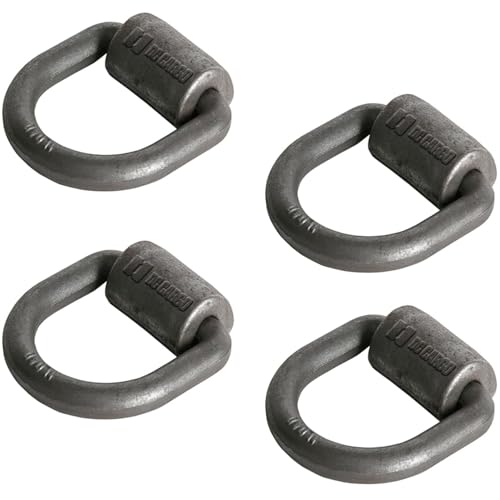
At the top of the strength table sits the weld-on. DC Cargo Mall’s ring is a 5/8 inch forged steel D-ring on a weldable bracket, sold four to a pack, and its published break strength is 18,900 pounds — a figure in a different league from everything else in this guide, because the mount is in a different league. A weld to a steel trailer frame makes the anchor and the frame one piece of metal. There are no bolts to loosen and no plate to pry up.
That permanence is the trade. The bracket welds to steel only — frame rails, equipment trailer decks, steel flatbeds — and it stays there. Welding belongs to a competent welder, and the weld itself becomes part of the inspection routine: a cracked weld bead retires the point just as a cracked ring does. For a dedicated equipment trailer that hauls the same heavy machine every week, this is the anchor that ends the search.
Specs
- Mount style: weld-on bracket, permanent, steel surfaces only
- Ring build: 5/8 in forged steel D-ring
- Break strength: 18,900 lb (maker figure)
- Pack: 4 anchors
- Best for: steel-frame equipment trailers and flatbeds hauling heavy machines
Comparison: Which Mount Goes Where
- Bed rails with stake pockets, no drilling wanted: the Buyers B38SP4 drops in, locks down, and comes back out.
- A deck that must stay flat: the Erickson 59114 folds into its pan and disappears under sliding loads.
- Several fixed points on a budget of holes, not anchors: the PAMAZY four-hole plate spreads each pull across four fasteners.
- Many points for light and medium loads: the JCHL V-ring ten-pack puts a loop wherever a strap line lands.
- Maximum strength on a steel frame: the DC Cargo weld-on makes anchor and frame a single piece.
Frequently Asked Questions
How many anchors does a trailer need?
Four corners is the starting point. Add a mid-deck pair on each side for long loads, and place points so each strap pulls down and slightly outward. The right count is the one that lets every strap run fair without a hard side angle.
Can I bolt an anchor through a wood deck plank alone?
For light duty with a wide backing plate beneath the plank, a through-bolted mount can serve. For heavy work, no — run the bolts into a steel plate or cross-member under the deck. The solid-mount rule decides: the anchor inherits the strength of whatever holds it.
What is the difference between break strength and working load limit?
Break strength is the pull at which the anchor can fail. The working load limit is the figure published for regular use, with margin built in. Plan every load against the working load limit, and remember the weakest link in the whole chain — anchor, strap, or hook — sets the figure for that line.
Do stake-pocket anchors fit every pickup?
No. Pockets vary by maker and year, and some are blocked by rail caps or bed liners. Confirm the pocket dimensions against the anchor’s stem before ordering, and seat the anchor fully before trusting it.
When should an anchor be replaced?
At the first crack at a weld, the first bent plate or ring, or when bolt holes have worn oval. Coating wear alone is maintenance; damaged steel is retirement.
Verdict
For most pickup owners, the Buyers stake-pocket set is the first buy: forged rings, an honest working figure, and zero holes in the truck. Trailer owners fitting out a deck should start with the PAMAZY plates for general points and add the Erickson recessed ring wherever loads slide. The JCHL ten-pack fills in the light-duty gaps, and the DC Cargo weld-on is the permanent answer on steel frames. Whichever set lands in the cart, the rules travel with it: through-bolts and backing plates, the weakest link sets the figure, and a cracked weld or bent mount ends an anchor’s service that day.
Related guides
More from Amazon
Programs that pair well with the guide above. Offers and eligibility are set by Amazon and may change.
A free business account with business pricing and bulk-buying tools for work, shop or home office.
Create a business accountFree shipping on eligible items, Prime Video and more. Eligible new members can start with a free trial.
Start a Prime free trialAudiobooks and podcasts to listen to on the go. Eligible new members can start with a free trial.
Try Audible freeAd-free music streaming. Eligible new subscribers can start with a free trial.
Try Music Unlimited freeAs an Amazon Associate we earn from qualifying purchases.








