
Key takeaways
- Compare mechanic stethoscopes, checking probe, hose, earpieces and case for engines, cars, garages, workshops, bearings, pulleys and finding odd noises.
What's inside
As an Amazon Associate I earn from qualifying purchases. This post may contain affiliate links at no extra cost to you.
A ticking lifter, a growling water pump bearing and a whining alternator can all sound like one vague rumble when you stand in front of an open hood. A mechanic stethoscope solves that problem the simple way: it carries sound from one exact contact point straight to your ears, so you can walk the probe from part to part and hear precisely where a noise starts and stops. It is one of the oldest diagnostic tools in the shop, and still one of the fastest ways to separate a failing pulley bearing from a healthy one before you unbolt anything.
This guide compares five mechanic stethoscopes that cover the full range of the class, from a basic steel probe rod to amplified electronic units with headphones. Every pick below is a listening tool for machines only — engines, gearboxes, bearings, pumps and chassis parts — not a medical instrument.
Disclosure: As an Amazon Associate, I earn from qualifying purchases. Product details were verified at the time of writing.
Contents
How to Choose a Mechanic Stethoscope
Probe type comes first. A solid metal probe rod transmits structure-borne sound: touch the tip to an alternator housing, a valve cover or a differential case and the vibration travels up the rod to a diaphragm chamber. This is what you want for bearings, injectors, gears and internal engine noises. Some kits add a hollow funnel or trumpet attachment that picks up air-borne sound instead, which is the right tool for vacuum leaks, exhaust leaks and wind noise around door seals.
Mechanical or electronic. A mechanical stethoscope has no batteries, nothing to charge and nothing to break; the diaphragm does all the work. An electronic stethoscope uses a microphone and an amplifier, so it can make faint sounds louder, tame painfully loud ones with volume control, and feed the signal into padded headphones that shut out shop noise. Electronics earn their keep on quiet modern engines and for noises you need to hear while the vehicle moves.
Probe length and reach. A longer probe keeps your hands and face further from belts, fans and hot manifolds, and reaches down to lower pulleys and transmission cases. Check that the probe is rigid — a flexing rod blurs the contact point and muddies the sound.
Hose and earpieces. The tubing should be flexible enough to move with you but thick enough not to transmit every brush against a fender. Earpieces matter more than most people expect: you will hold them in place for minutes at a time while an engine idles, so soft, well-sealing tips make the tool far easier to use. On electronic models, closed headphones do the same job and add hearing protection against sudden loud contact noise.
Storage. Probes bend and diaphragms dent. A case, or a design that breaks down into short sections, keeps the tool accurate and ready in a drawer or road kit.
The 5 Best Mechanic Stethoscopes
1. Lisle 52500 Mechanic’s Stethoscope

The Lisle 52500 is the classic single-probe design that most technicians start with. Its stainless steel probe feeds a sound chamber with a super thin diaphragm, a combination that amplifies contact noise strongly while keeping the tool light enough to hold against a part for long listening sessions. It is built to pinpoint noises in engines, transmissions, differentials and bearings, and the all-metal construction shrugs off the heat and grime around an engine bay. If you want one straightforward mechanical stethoscope that covers the everyday jobs — a noisy idler pulley, a clicking injector, a rumbling wheel bearing checked on the lift — this is the benchmark the rest of the class is measured against.
Specs
- Type: Mechanical probe stethoscope
- Probe: Stainless steel needle probe
- Listening head: Diaphragm sound chamber
- Weight: 1.76 oz
- Warranty: Limited lifetime
2. GEARWRENCH 835D Mechanic’s Stethoscope
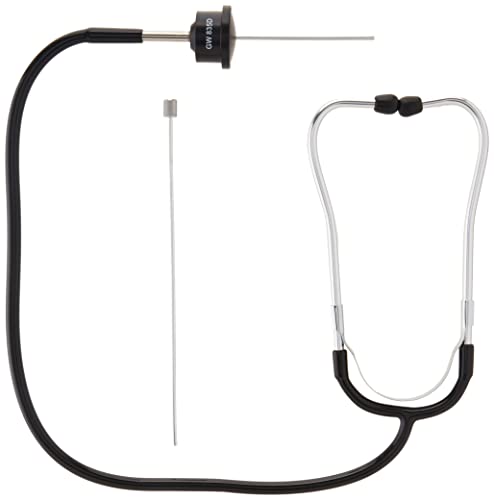
The GEARWRENCH 835D takes the same probe-and-diaphragm layout and adds shop-friendly details. The handle is shock resistant, so the sharp crack you get when the probe tip slips or taps metal is softened before it reaches your ears — a small feature you appreciate within the first minute of use. The tool also disassembles into shorter sections, which makes it easy to store flat in a tool chest drawer or a mobile kit without bending the probe. For a home garage or workshop that handles a mix of car work and machinery, it is a durable step up from the most basic designs.
Specs
- Type: Mechanical probe stethoscope
- Handle: Shock-resistant grip
- Storage: Disassembles for compact storage
- Model: 835D
- Warranty: Lifetime
3. Lisle 52750 Dual Purpose Stethoscope Kit

The Lisle 52750 kit covers both families of noise in one box. Use the steel probe for mechanical, structure-borne sounds — bearings, gears, injectors, valves — then swap to the funnel attachment to listen for air-borne sounds such as vacuum hose leaks, exhaust manifold leaks, and air escaping around gaskets and seals. That second mode is something a probe-only tool simply cannot do well, and it makes this kit the most versatile mechanical option here. If your diagnostic work regularly includes hunting a hiss as well as a knock, the 52750 is the pick.
Specs
- Type: Mechanical dual-purpose kit
- Attachments: Needle probe and listening funnel
- Sound modes: Structure-borne and air-borne
- Model: 52750
- Use: Mechanical noises plus vacuum and exhaust leak detection
4. Steelman EngineEAR II Electronic Stethoscope

The Steelman EngineEAR II (model 06800) replaces the diaphragm with a non-conductive microphone probe and an amplifier. A built-in decibel meter with an LED readout shows sound levels across a 60 to 120 decibel range, and multiple sound level settings let you raise a faint bearing whine or pull back a harsh gear noise to a comfortable volume. Because the microphone is non-conductive, it is safe to use around ignition components and electrical parts where a bare metal rod would be a poor idea. Supplied headphones seal out the surrounding shop noise so you hear the part, not the room. This is the tool for faint, intermittent or electrical-area noises that a passive probe struggles with.
Specs
- Type: Electronic stethoscope
- Meter: LED decibel display, 60–120 dB range
- Microphone: Non-conductive probe microphone
- Sound levels: Multiple adjustable settings
- Output: Headphones
- Model: 06800
5. OTC 3590 Electronic Stethoscope

The OTC 3590 is a professional electronic stethoscope built for technicians who chase noises all day. Amplification with volume control lets you work methodically across an engine or driveline, comparing one bearing or injector against the next at a consistent listening level, and the headphone output keeps the signal isolated from ambient noise. It suits the jobs where a passive tool reaches its limits: quiet late-model engines, noises buried under covers, and components you can only reach with the probe while standing back. For a busy garage, it is the heavy-duty end of this lineup.
Specs
- Type: Electronic stethoscope
- Sound path: Amplified microphone with volume control
- Output: Headphones
- Model: 3590
- Use: Engine, driveline and chassis noise isolation
Comparison Table
| Product | Type | Probe / Pickup | Sound Path | Standout Spec |
|---|---|---|---|---|
| Lisle 52500 | Mechanical | Stainless steel needle probe | Diaphragm sound chamber | 1.76 oz weight |
| GEARWRENCH 835D | Mechanical | Steel probe | Diaphragm, shock-resistant handle | Disassembles for storage |
| Lisle 52750 Kit | Mechanical | Needle probe + funnel | Diaphragm, two attachments | Air-borne leak listening |
| Steelman EngineEAR II | Electronic | Non-conductive microphone | Amplifier, LED dB meter | 60–120 dB range |
| OTC 3590 | Electronic | Microphone probe | Amplifier with volume control | Headphone output |
FAQ
Can a mechanic stethoscope find a bad wheel bearing?
Yes. With the vehicle safely raised and the wheel turning, touch the probe to the steering knuckle or hub area on each side. A failing bearing growls or rumbles noticeably louder than the healthy side, and comparing sides is the quickest confirmation.
What is the difference between the probe and the funnel?
The probe carries vibration through solid contact, so it hears internal mechanical parts. The funnel gathers sound from the air, which is how you trace vacuum leaks, exhaust leaks and other hissing noises that a contact probe misses.
Are electronic stethoscopes worth it over mechanical ones?
For loud, obvious noises, a mechanical tool is enough and never needs batteries. Electronics earn their place on faint or intermittent sounds, on quiet modern engines, and anywhere you need volume control or headphone isolation from shop noise.
Is it safe to use around a running engine?
Work carefully: keep the probe, hose, your hands and loose clothing clear of belts, fans and pulleys, and avoid touching ignition components with a bare metal probe. An electronic model with a non-conductive microphone is the safer choice near electrical parts.
Can I use one on machinery besides cars?
Absolutely. The same listening method works on workshop machinery, pumps, compressors, gearboxes and appliances — anywhere a bearing, gear or motor makes a noise you need to locate.
Verdict
For most home garages, the Lisle 52500 covers the core job with a light, tough, all-mechanical design. The GEARWRENCH 835D adds ear comfort and flat storage, while the Lisle 52750 kit is the most versatile mechanical choice thanks to its funnel for leak hunting. When the noise is faint, buried or near electrical components, step up to an electronic unit: the Steelman EngineEAR II brings a decibel meter and a non-conductive microphone, and the OTC 3590 is the professional amplifier for all-day diagnostic work. Match the tool to the noises you chase most, and any of these five will find sounds your ears alone cannot place.
Related guides
More from Amazon
Programs that pair well with the guide above. Offers and eligibility are set by Amazon and may change.
A free business account with business pricing and bulk-buying tools for work, shop or home office.
Create a business accountFree shipping on eligible items, Prime Video and more. Eligible new members can start with a free trial.
Start a Prime free trialAudiobooks and podcasts to listen to on the go. Eligible new members can start with a free trial.
Try Audible freeAd-free music streaming. Eligible new subscribers can start with a free trial.
Try Music Unlimited freeAs an Amazon Associate we earn from qualifying purchases.








