What's inside
- Quick comparison of the best electric wheelchairs
- Best electric wheelchair for small rooms and workshops: WHILL C2
- Best lightweight option: Pride Jazzy Carbon
- Best high-capacity indoor chair: Pride Jazzy 614 HD
- Best for regular outdoor use: Permobil M3
- How to choose by situation
- Fit, turning radius, and doorway calculation
- Battery range and charging requirements
- Terrain handling and durability realities
- Final buying checklist
As an Amazon Associate I earn from qualifying purchases. This post may contain affiliate links at no extra cost to you.
The best electric wheelchairs for most buyers are the WHILL C2 for indoor maneuverability, the Jazzy Carbon for a lighter folding-style design, and the Permobil M3 for demanding outdoor use and advanced seating support—but the right choice depends on turning space, body dimensions, terrain, transport, and charging access.
As an Amazon Associate we earn from qualifying purchases at no extra cost to you.


Contents
- Quick comparison of the best electric wheelchairs
- Best electric wheelchair for small rooms and workshops: WHILL C2
- Best lightweight option: Pride Jazzy Carbon
- Best high-capacity indoor chair: Pride Jazzy 614 HD
- Best for regular outdoor use: Permobil M3
- How to choose by situation
- Fit, turning radius, and doorway calculation
- Battery range and charging requirements
- Terrain handling and durability realities
- Final buying checklist
Our Top Picks
 32lbs Lightweight Electric WheelchairBlack-360W-16.5" Seat Width35 x 21.5 x 37 inches35 PoundsCheck on Amazon
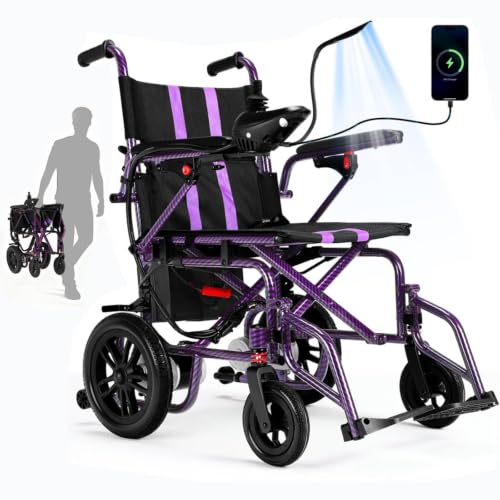 Electric Wheelchairs for Adults,Lightweight Foldable Wheelchair 15 Miles12.2'' x 26.7''Check on Amazon


Quick comparison of the best electric wheelchairs
The figures below are representative manufacturer specifications and can vary with battery, seat, and configuration. Confirm the exact version before ordering, especially if the chair must fit through a doorway or be lifted into a vehicle.
| Chair or type | Approx. width | Turning radius | Weight capacity | Chair weight | Typical range | Best use |
|---|---|---|---|---|---|---|
| WHILL C2 | 23.6 in | 30 in | 330 lb | 115–128 lb | 10 miles | Indoor use and smooth outdoor paths |
| Pride Jazzy Carbon | 24.5 in | 31.5 in | 300 lb | 59 lb without battery | 9.3 miles | Portable travel and occasional indoor use |
| Drive Titan HMV | 24 in | 31 in | 300 lb | 77 lb without battery | 10 miles | Compact general-purpose travel |
| Pride Jazzy 614 HD | 24.5 in | 20.75 in | 450 lb | About 275 lb | 15.7 miles | Very tight indoor turning and higher capacity |
| Permobil M3 | 24.5–25.5 in | About 20 in | 300 lb | About 350 lb | Up to about 20 miles | Full-time indoor and outdoor mobility |
“Range” is not a guarantee. Rider weight, temperature, hills, tire pressure, surface type, battery age, and repeated acceleration can reduce it substantially. A useful planning assumption is to use only 60–70% of the advertised range for regular trips, leaving a reserve for detours and battery aging.
Best electric wheelchair for small rooms and workshops: WHILL C2
The WHILL C2 is particularly attractive where a wheelchair must navigate a kitchen, office, hallway, or compact workshop. Its compact turning circle and unusual front omni-wheels allow it to pivot and maneuver around furniture more easily than many conventional rear-wheel-drive chairs. The enclosed front-wheel design can also be less prone to catching on small floor transitions than a basic caster arrangement.
Its limitations matter. The C2 is relatively heavy for a chair described as portable, and its approximately 10-mile range is better suited to local trips than all-day outdoor travel. It is intended for paved surfaces and maintained paths, not deep gravel, mud, steep uneven ground, or construction-site conditions. For a woodworking shop, keep sawdust and shavings away from the wheel housings, joystick, charging socket, and ventilation openings.
Best lightweight option: Pride Jazzy Carbon
The Jazzy Carbon is one of the more practical choices when portability is the main requirement. Its carbon-fiber frame keeps the base far lighter than a full-size power wheelchair, and it can be disassembled or folded depending on configuration. This is useful for occasional travel, storing the chair in a closet, or loading it into a vehicle with a ramp or lifting aid.
Lightweight chairs make compromises. The smaller drive wheels and lighter frame are less forgiving on grass, broken pavement, thresholds, and slopes. A 59-pound base may still be difficult for one person to lift safely once the battery and removable components are included. Measure the vehicle opening and verify the lifting method rather than assuming “folding” means easy to carry.
For primarily indoor use, check the seat depth and armrest width carefully. A compact chair can fit through doors while still being uncomfortable if the seat is too short or narrow.
Best high-capacity indoor chair: Pride Jazzy 614 HD
The Jazzy 614 HD is a stronger candidate for users who need a higher weight rating without giving up excellent indoor maneuverability. Its mid-wheel-drive layout places the drive wheels near the user’s center of gravity, helping the chair turn within a small area. The 450-pound capacity is also substantially higher than that of many lightweight travel models.
The trade-off is transportability. This is a substantial powered base, not a chair most people will lift into a car. It is better matched with a wheelchair-accessible van, a vehicle lift, or a permanently accessible home. Its small center drive wheels can climb common thresholds, but they still require sensible approach angles and adequate clearance.
Best for regular outdoor use: Permobil M3
The Permobil M3 is designed as a full-time power wheelchair rather than a simple travel mobility device. It offers a stable base, suspension, programmable drive performance, and extensive seating configurations. Those features can improve control on ramps, uneven sidewalks, and longer outdoor journeys, while the mid-wheel layout keeps turning performance strong indoors.
This capability comes with considerable cost and ownership complexity. A configured power chair in this class may cost roughly $15,000 to more than $30,000 before insurance, accessories, or specialized seating, whereas lightweight and basic indoor models often fall in the approximate $2,000–$8,000 range. A professional seating assessment is especially important when the chair will be used for many hours each day.
How to choose by situation
| Your situation | Priority | Most suitable direction | What to avoid |
|---|---|---|---|
| Small home or workshop | Turning radius and width | Compact mid-wheel or WHILL-style omni-wheel chair | Wide outdoor base that cannot turn between benches |
| Occasional trips by car | Low transport weight | Lightweight folding or modular chair | Assuming the heaviest component is safe to lift |
| Daily outdoor travel | Ground clearance, suspension, battery reserve | Full-size rear- or mid-wheel power chair | Small travel wheels on gravel or steep slopes |
| Higher body weight | Capacity, seat width, frame durability | Heavy-duty model rated comfortably above the user’s weight | Buying exactly at the published limit |
| Full-time use | Posture, pressure management, service support | Professionally configured complex rehab chair | Choosing solely by advertised range or price |
Fit, turning radius, and doorway calculation
Measure the narrowest doorway, then allow clearance rather than matching the chair width exactly. For example, a 27-inch doorway and a 24-inch chair leave only 1.5 inches per side. That may be technically possible, but a threshold, door trim, or imperfect approach can make it frustrating. A practical target is at least 2 inches of total spare width, and more if the user cannot approach the doorway squarely.
Turning radius is also frequently misunderstood. A quoted turning radius is not the same as the diameter of the full circle. If a chair has a 20-inch turning radius, plan on approximately 40 inches for the turning circle, plus room for the footplates and rear of the chair. In a workshop, leave extra space around clamps, lumber, cords, and table saw outfeed areas.
Battery range and charging requirements
Most electric wheelchairs use sealed lead-acid or lithium-ion battery systems. Lead-acid batteries are generally heavier and may require more frequent replacement, while lithium systems can reduce weight but may cost more and require model-specific charging equipment. Never substitute a charger solely because its plug fits; voltage, current, charging profile, and battery chemistry must match the chair.
A simple range calculation illustrates why reserve matters. If a chair advertises 10 miles but real conditions deliver 70% of that figure, usable planning range is about 7 miles. A 4-mile round trip consumes roughly 57% of that reserve, leaving less margin for hills, cold weather, or battery aging. Charge after trips rather than repeatedly waiting until the battery is nearly empty, and follow the manufacturer’s storage instructions if the chair will sit unused.
Keep the charger on a dry, ventilated, nonflammable surface. Do not cover it during operation, use a damaged cable, or charge where sawdust can collect around electrical connections. Battery replacement intervals vary widely, but heavy daily use commonly makes batteries a several-year consumable rather than a lifetime component.
Terrain handling and durability realities
Rear-wheel-drive chairs often feel stable at speed and can be useful outdoors, but they usually need more room to turn. Mid-wheel models turn tightly and suit interiors, although their center wheels and front casters need careful alignment at curbs and thresholds. Front-wheel-drive chairs can handle some obstacles well, but their longer turning path may be inconvenient in narrow rooms.
The parts that commonly wear first are tires, casters, armrest pads, joystick boots, footplate hardware, and batteries. Hair, string, and wood shavings can wind around axles. Inspect wheels weekly if the chair is used in a workshop, wipe exposed surfaces with a slightly damp cloth, and use only cleaning products approved for the upholstery and electronics. Do not pressure-wash the base.
Final buying checklist
- Measure every doorway, elevator, ramp, and storage area.
- Compare the complete chair weight, not only the removable base.
- Choose a capacity with a meaningful margin above the user’s weight and belongings.
- Use real-world range estimates rather than the best laboratory figure.
- Confirm whether the battery is airline-approved, removable, or vehicle-lift compatible if travel matters.
- Ask about local repairs, replacement batteries, tires, joystick parts, and warranty coverage.
- For full-time use, arrange an assessment with a qualified seating and mobility professional.
For a tight indoor layout, start with the WHILL C2 or a compact mid-wheel chair. For occasional vehicle transport, prioritize a genuinely manageable lightweight model such as the Jazzy Carbon. For daily outdoor travel or full-time seating needs, accept the extra size and cost of a properly configured chair such as the Permobil M3.