
Our Top Picks
 Klein Tools ET120 Gas Leak Detector1.79 x 2.71 x 28.3 Inch28.3 x 1.79 x 2.71 inches0.8 PoundsCheck on Amazon
 UEi Test Instruments CD100A Combustible Gas Leak DetectorOne Size1.5 x 4 x 8 Inches0.1 poundsCheck on Amazon
What's inside
As an Amazon Associate I earn from qualifying purchases. This post may contain affiliate links at no extra cost to you.
A combustible gas leak detector, often called a sniffer, is a handheld tool that finds where fuel gas is escaping, not just that gas is present somewhere in the room. You move the sensor tip slowly along pipe joints, union nuts, flex lines and appliance valves, and the alarms climb as the tip nears the leak. That pinpointing job separates a sniffer from a plug-in wall alarm, which only watches one room, and from a refrigerant leak detector, which is tuned to halocarbon gases rather than to methane and propane.
Disclosure: As an Amazon Associate, I earn from qualifying purchases. Product details were verified at the time of writing.
One safety note before the picks. A sniffer is a tool for checking your own work and hunting down a faint smell. If you walk into a strong gas odor, leave the building, skip the light switches, and call your gas utility or the emergency line from outside. Use the detectors below for the quieter jobs: confirming a fitting you just tightened, checking a water heater union, or tracing a weak smell around a furnace, a stove line or an RV propane system.
How to Choose a Gas Leak Detector
Sensor type. Nearly every handheld sniffer in this class uses a heated semiconductor sensor. It reacts to a wide family of combustible gases at once, which makes it a good general hunter but means it cannot tell you which gas it found, and solvents, paint fumes and even hand sanitizer vapor can set it off. Sensitivity figures are quoted on a methane basis, so compare those numbers rather than the marketing names.
Sensitivity and range. The lowest level a detector can pick up decides how small a seep it can find. A threshold near 50 ppm handles most household work. Two-range models and adjustable tick rates help twice over: the keen setting finds the faint trace, then the lower setting keeps the alarm from maxing out while you close in on the exact joint.
Probe style and length. A flexible gooseneck of 14 to 18 inches reaches behind ranges, under water heaters and into furnace cabinets, where fittings rarely sit in the open. Pen-style detectors skip the probe and ride in a shirt pocket, but the tip must sit within a few centimeters of the joint. A small light at the probe tip is worth having in dark cabinets and crawl spaces.
Alarms. Rising beeps and LED bars are the baseline. Vibration alerts earn their keep in a loud workshop where a beep disappears under saw noise, and a backlit display that changes color at high levels is easy to read at a glance. Confirm any electronic hit with leak-detection fluid before you break out the wrenches.
Power and upkeep. Detectors that run on AA or AAA cells are easy to feed from a drawer, while rechargeable pro units trade that convenience for longer continuous runs. Every sniffer needs a warm-up and a fresh-air zero before it reads honestly, and models with a field-replaceable sensor stay in service for years instead of becoming e-waste when the sensor tires. For work in classified hazardous locations, look for an intrinsically safe listing.
The 5 Best Gas Leak Detectors
1. Klein Tools ET120 Gas Leak Detector
The ET120 is the all-rounder most inspectors and HVAC techs reach for first. Its two sensitivity ranges split the work cleanly: the high range sniffs out faint traces from 50 ppm, and the low range takes over up to 10,000 ppm so you can walk a strong leak down to the exact fitting without the alarm pegging. The 18-inch gooseneck clips onto the body for storage, automatic zero calibration runs at every startup, and the over-molded housing shrugs off the drops that happen around furnaces and meter sets. A pouch and batteries come in the box, so it is ready for a service call the day it arrives.
Specs
– Sensor type: Semiconductor
– Sensitivity: 50 ppm (methane); High range 50 to 1,000 ppm, Low range 1,000 to 10,000 ppm
– Probe: 18 in flexible gooseneck
– Alarms: 5 red LEDs plus an 85 dB audible tone that intensifies with concentration
– Power: 4 AAA batteries (included), auto shutoff after 10 minutes
– Extras: Automatic zero-point calibration at startup, storage pouch included
2. UEi Test Instruments CD100A Combustible Gas Leak Detector
The CD100A is the classic tick-rate sniffer, and its simple thumbwheel is still a pleasure to use. You dial in a slow, steady tick in clean air, then sweep the probe along a line; the tick speeds up as gas reaches the sensor, letting you work by ear while your eyes stay on the pipework. The 18-inch gooseneck ends in a tip light that illuminates the joint you are checking, a small feature that matters inside a dark furnace cabinet. It responds to many gases beyond natural gas and propane, including ammonia, butane and gasoline, and the sensor can be swapped when it wears down.
Specs
– Sensor type: Solid-state semiconductor
– Sensitivity: 50 ppm
– Probe: 18 in gooseneck with a light in the sensor tip
– Alarms: Adjustable audible tick rate with a flashing LED
– Power: 9V alkaline battery, about 5 hours of typical use
– Extras: Headphone jack for loud sites, replaceable sensor, one-year limited warranty
3. RIDGID micro CD-100 Combustible Gas Detector (36163)

RIDGID built the micro CD-100 for noisy, awkward job sites. Its Tri-Mode alerting combines lights and sound with a vibration alarm, so a hit registers even when a saw or compressor is running nearby. The alarm threshold sits at 40 ppm on methane, a touch keener than most, and adjustable sensitivity lets you desensitize the unit as you narrow in on a fitting. The 16-inch flexible probe covers the usual behind-the-appliance work, automatic calibration runs at startup, and the sensor is field-replaceable, which keeps a pro tool in service instead of on a shelf. It runs on common AA cells, another nod to life in a service truck.
Specs
– Sensor type: Semiconductor (heated element)
– Sensitivity: 40 ppm alarm threshold; detection range 0 to 6,400 ppm (methane)
– Probe: 16 in flexible probe
– Alarms: Visual, audible and vibration (Tri-Mode)
– Power: 4 AA batteries
– Extras: Field-replaceable sensor, adjustable sensitivity, automatic calibration
4. Robinair TIF8800X Combustible Gas Detector

The TIF8800X is the heavy-duty pick for fuel work and hazardous locations. It carries a UL 913 intrinsically safe listing for Division 1 areas, which is why it shows up around propane filling stations, fuel lines and marine bilges where a lesser tool should not go. Sensitivity adjusts down to 1 ppm on gasoline, the LED bar shows leak level while a Geiger-style signal quickens near the source, and the whole unit runs one-handed. A rechargeable pack gives about four hours of continuous hunting, and the coated 14-inch probe and rubber boot suit greasy, knockabout work.
Specs
– Sensor type: Solid-state semiconductor
– Sensitivity: Variable, down to 1 ppm (gasoline)
– Probe: 14 in flexible probe
– Alarms: LED leak level indicator plus an audible signal that increases in frequency near the source
– Power: Rechargeable battery pack, about 4 hours of continuous use, charger included
– Extras: UL 913 intrinsically safe for Division 1 hazardous locations, adjustable sensitivity thumbwheel
5. TopTes PT199 Natural Gas Leak Detector
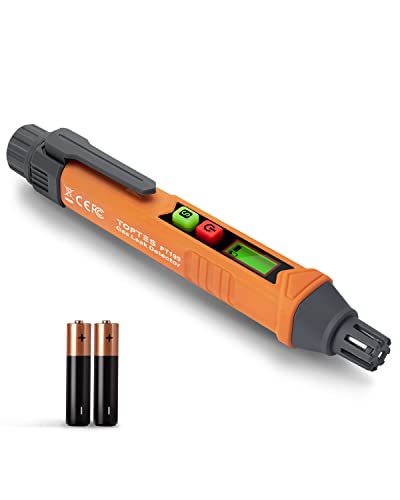
The PT199 is the pocket option for homeowners and RV owners who want a checker in the drawer rather than a full service tool. It is pen-sized with a pocket clip, warms up in about 30 seconds, and answers in half a second: a seven-bar graph fills, a 75 dB alarm rises, and the screen turns red when levels get high. Two sensitivity ranges cover 50 to 1,000 ppm on methane, plenty for stove connections, grill hoses, water heater unions and RV propane fittings. There is no probe, so the tip has to sit within a few centimeters of the joint, but for spot checks after your own plumbing work that trade is fair, and the batteries and a storage bag are included.
Specs
– Sensor type: Gas-sensitive semiconductor
– Sensitivity: 50 ppm; High range 50 to 500 ppm, Low range 500 to 1,000 ppm (methane)
– Probe: None, fixed tip; hold 1 to 5 cm from the joint being checked
– Alarms: 7-bar graph, 75 dB audible alarm, LCD turns red at high concentration
– Power: 2 AAA batteries (included), auto shutoff after 5 minutes
– Extras: Response time of 0.5 seconds, 30-second warm-up, storage bag included
Comparison Table
| Detector | Sensor | Lowest sensitivity | Probe | Alarm styles | Power |
|---|---|---|---|---|---|
| Klein Tools ET120 | Semiconductor | 50 ppm | 18 in gooseneck | LED bar, audible | 4 AAA |
| UEi CD100A | Solid-state semiconductor | 50 ppm | 18 in gooseneck with tip light | Audible tick, LED | 9V |
| RIDGID micro CD-100 | Semiconductor | 40 ppm | 16 in flexible probe | Visual, audible, vibration | 4 AA |
| Robinair TIF8800X | Solid-state semiconductor | 1 ppm (gasoline) | 14 in flexible probe | LED bar, audible | Rechargeable pack |
| TopTes PT199 | Gas-sensitive semiconductor | 50 ppm | None (fixed tip) | Bar graph, audible, color LCD | 2 AAA |
FAQ
Can a gas leak detector also find carbon monoxide?
No. The sniffers in this guide react to combustible gases such as methane and propane. Carbon monoxide needs its own sensor and its own alarm, so keep a dedicated CO alarm on each level of the home regardless of which detector you buy.
Do I need a sniffer if I already have a plug-in gas alarm?
They do different jobs. A plug-in alarm stands watch around the clock and wakes the house if gas builds up, but it cannot tell you which fitting is leaking. A sniffer is the tool you carry to the pipework to find the source once you suspect a problem, or to verify your own repair.
How do I get a trustworthy reading?
Turn the detector on in clean outdoor air and let it finish its warm-up and zero routine. Then move the tip slowly along joints and valves, pausing at each fitting. Work from areas of low concentration toward the strongest signal, and confirm the final spot with leak-detection fluid before tightening or replacing anything.
Why does my detector react near paint, solvents or cleaning sprays?
Semiconductor sensors respond to many vapors besides fuel gas, including alcohol, paint fumes and some aerosols. A reaction near fresh paint or a solvent bottle is expected behavior, not a fault. Clear the air, re-zero the unit, and check the fitting again.
How long does the sensor last?
Sensor life varies with exposure, and heavy hits of gas or silicone vapor shorten it. Models with replaceable sensors, like the CD100A and the micro CD-100, can be refreshed at home. If a detector stops responding during a maker-approved function check against a known small source, treat the sensor as done.
Verdict
For most homes and workshops, the Klein Tools ET120 hits the balance: two honest sensitivity ranges, a long gooseneck and alarms you can read at a glance. The UEi CD100A remains the pick for anyone who prefers an adjustable tick rate and a tip light, while the RIDGID micro CD-100 earns its place on loud job sites with its vibration alarm and keen 40 ppm threshold. Step up to the Robinair TIF8800X when the work involves fuel vapor or classified locations, and keep the TopTes PT199 in a kitchen drawer or RV cabinet for quick checks of the fittings you can already reach.
Related guides
More from Amazon
Programs that pair well with the guide above. Offers and eligibility are set by Amazon and may change.
A free business account with business pricing and bulk-buying tools for work, shop or home office.
Create a business accountFree shipping on eligible items, Prime Video and more. Eligible new members can start with a free trial.
Start a Prime free trialAudiobooks and podcasts to listen to on the go. Eligible new members can start with a free trial.
Try Audible freeAd-free music streaming. Eligible new subscribers can start with a free trial.
Try Music Unlimited freeAs an Amazon Associate we earn from qualifying purchases.








