
Key takeaways
- Compare the best straightedges by length, material, edge style and accuracy figure, from steel rules to cast iron edges, for layout and machine setup work.
As an Amazon Associate I earn from qualifying purchases. This post may contain affiliate links at no extra cost to you.
Every flat surface in a workshop is only as trustworthy as the reference you check it against. A jointer bed, a freshly flattened board, a table saw top: none of them can tell you whether they are flat. A straightedge can. Held on edge against the work with a light behind it, or paired with feeler gauges, it turns invisible humps and hollows into a gap you can see and measure. It is also the tool that aligns jointer tables, confirms a planer bed, and draws the long layout lines that a short square cannot reach.
Disclosure: As an Amazon Associate, I earn from qualifying purchases. Product details were verified at the time of writing.
The five straightedges below span the lengths a woodworking shop actually uses. There is an 18 in aluminum edge for benchtop checks, two 24 in edges in aluminum with different edge styles, a 38 in aluminum edge for jointer beds and wide panels, and a 72 in precision ground steel edge for full-length machine setup. They differ in length, material, edge style, and the accuracy figure the maker publishes, and the choosing guide below walks through those points in order. Note that these are reference edges for checking and layout, not clamp-on saw guides: the job here is measuring truth, not steering a blade.
How to Choose a Straightedge
Match the length to the surface. A straightedge only reports on the span it covers. An 18 or 24 in edge is right for bench planes, machine tables on benchtop tools, and boards up to its length. Jointer beds, long workbench tops, and wide glue-ups need 36 in or more, because a short edge rides over a long, shallow hollow without ever showing a gap. The 72 in class exists for full-size jointers and for checking long stock end to end. Buy for the longest surface you check often; a second, shorter edge is easier to handle for daily layout.
Steel or aluminum. Precision ground tool steel holds an edge through decades of shop knocks and is the traditional machinist material, but a long steel edge is heavy, and that weight matters when you are holding it on edge against a vertical fence. Aluminum edges are far lighter, will not rust, and modern machining holds them to figures that suit woodworking tolerances well. Anodized aluminum also shrugs off the dents that a bare soft edge would pick up. Steel earns its place at the longest lengths and in metalworking crossover shops; aluminum wins on handling everywhere else.
Read the accuracy figure carefully. Makers state straightness two ways: as a total over the full length, or as a figure per foot. A 24 in edge machined flat to within 0.001 in over its full length is a tighter tool than one stated at 0.0015 in per foot, which can add up to roughly 0.003 in across two feet. Neither figure is a grade or a certification; it is the maker’s published machining tolerance, and it tells you the size of gap the edge itself might hide. For woodworking setup, anything at or under about 0.003 in over the working length resolves every gap that matters, because feeler gauges start at 0.0015 in and wood moves more than that with the weather.
Edge style decides the second job. A plain square edge does one thing: it checks surfaces. A beveled edge slides a scale or a knife line right down against the work and reads gaps more clearly against the light. A graduated edge adds a rule, so the same tool lays out and measures. A vee-groove base edge stands up on its own, which frees both hands for feeler gauges while you adjust a machine. Decide whether your straightedge is purely a reference or also a layout tool before you pick.
Protect the edge you paid for. A straightedge is a reference, and a reference with a nick in it lies to you forever after. Look for a case, a hanging hole, or at least a maker who expects the tool to live in a sleeve. Store it hung or cased, never loose in a drawer of chisels, and never use it as a pry, a paint can opener, or a guide for a utility knife on abrasive stock.
The 5 Best Straightedges
1. Woodpeckers SERXL-24 Straight Edge Rule — 24 in, Freestanding Vee-Groove Base
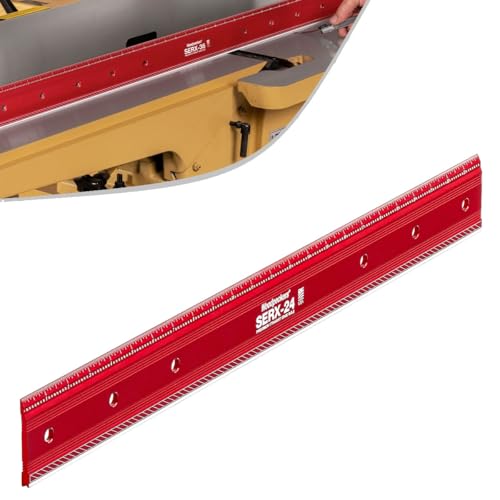
Woodpeckers machines this edge in Ohio from aircraft-grade aluminum and gives it a profile no plain bar has: an inverted vee-groove along the base edge, so the tool stands upright on its own two feet while you work. Set it across a jointer’s infeed and outfeed tables and both hands stay free for feeler gauges and adjustment wrenches. The opposite edge is beveled at 30 degrees and laser engraved with a scale, so it doubles as a layout rule that puts its markings right against the work. A bright white bar engraved along the bottom edge makes low spots show as dark gaps. It ships in an MDF case, which a reference tool deserves.
Specs
- Length: 24 in
- Material: aircraft-grade aluminum
- Edge style: inverted vee-groove freestanding base edge; 30 degree beveled, laser-engraved graduated edge (1/16 in graduations)
- Accuracy figure: machined to 0.0015 in per foot; engraved scale within ±0.004 in over the full length
- ASIN: B004BG3VK0
2. POWERTEC 71227 Anodized Aluminum Straight Edge — 24 in, Machined Flat

The 71227 is a one-piece anodized aluminum bar, 24 in long and 2 in wide, machined flat along its reference face and etched with inch and millimeter scales on both sides. Where the Woodpeckers edge above is a setup specialist, this is the general-purpose bench edge: long enough for benchtop jointers, planer beds, and panel glue-ups, light enough to grab one-handed for a quick board check. The 5/16 in measuring surface gives the edge a stable seat on narrow work, and the anodized finish keeps the etched scales legible after years of sliding across cast iron.
Specs
- Length: 24 in
- Material: anodized aluminum, one-piece construction
- Edge style: machined flat reference edge with dual-sided etched inch and millimeter scales
- Accuracy figure: machined flat to within 0.001 in over the full 24 in
- ASIN: B07NBQ5HSQ
3. POWERTEC 71332 Anodized Aluminum Straight Edge — 38 in
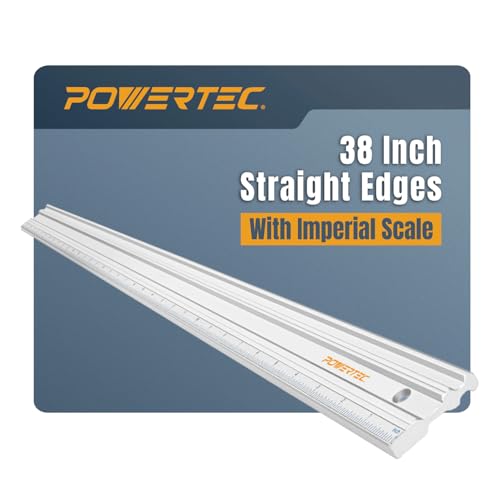
Thirty-eight inches is the length that covers a full-size jointer bed, a long workbench top, and the diagonal of most cabinet panels, and it is the length short edges cannot fake. The 71332 stretches POWERTEC’s anodized aluminum pattern to that span, with the same dual-sided etched inch and millimeter scales as its 24 in sibling. The longer bar flexes more than a short one if you lean on its middle, so use it laid on edge with a light touch at the ends; used that way, its published figure is honest across the whole span. For shops with one long machine to keep in tune, this is the practical step up.
Specs
- Length: 38 in
- Material: anodized aluminum
- Edge style: machined flat reference edge with etched inch and millimeter scales
- Accuracy figure: machined flat to within 0.003 in over the full 38 in
- ASIN: B07R6RK87W
4. DuBois 51024 Machinist Aluminum Straight Edge — 18 in

The shortest edge in this group earns its place on the bench, not the machine stand. Eighteen inches spans a bench plane sole, a benchtop planer bed, a router table insert, and most individual boards before glue-up, and the compact bar stores in a drawer or hangs by the bench where a long edge would live across the shop. DuBois aims it at machinist-style work: checking surface warp with feeler gauges, scribing lines, and verifying small castings. It is the edge you will reach for daily, precisely because it is never a chore to fetch.
Specs
- Length: 18 in
- Material: aluminum
- Edge style: machinist reference edge for feeler-gauge checks and scribing
- Accuracy figure: 0.001 in tolerance figure stated by the maker
- ASIN: B09ZPDL1VX
5. Starrett 385-72 Steel Straight Edge — 72 in, Beveled Edge

Starrett’s 385 series is the classic American machinist straight edge: precision ground tool steel, finished to the company’s own rigid standards, with one edge beveled and no graduations to interrupt the reference face. At 72 in, this is the edge for full-length jointer beds, long planer tables, and checking the longest stock a shop handles. Starrett marks arrows at the two suspension points on its 36 in and longer edges; support or hang the tool at those points and its own weight cannot bow it out of truth. It is heavy, it wants a case or a wall rack, and treated that way it will outlast every machine it aligns.
Specs
- Length: 72 in
- Material: precision ground tool steel
- Edge style: one beveled edge, not graduated; suspension points marked with arrows
- Accuracy figure: ±0.0002 in per foot, the maker’s published figure for its steel straight edges
- ASIN: B0006J4FT2
Comparison Table
| Model | Length | Material | Edge style | Accuracy figure |
|---|---|---|---|---|
| Woodpeckers SERXL-24 | 24 in | Aircraft-grade aluminum | Vee-groove freestanding base; beveled graduated edge | 0.0015 in per foot |
| POWERTEC 71227 | 24 in | Anodized aluminum | Machined flat edge, etched inch/mm scales | Within 0.001 in over full length |
| POWERTEC 71332 | 38 in | Anodized aluminum | Machined flat edge, etched inch/mm scales | Within 0.003 in over full length |
| DuBois 51024 | 18 in | Aluminum | Machinist reference edge | 0.001 in maker tolerance figure |
| Starrett 385-72 | 72 in | Precision ground tool steel | One beveled edge, not graduated | ±0.0002 in per foot |
FAQ
What length straightedge does a woodworking shop need first?
A 24 in edge covers benchtop machines, plane soles, and most boards, and it is the right first purchase. Add a 36 to 38 in edge when you own a full-size jointer, and treat a 72 in edge as a machine-setup tool rather than a bench tool.
How do I use a straightedge to check a board or a machine table?
Rest the edge on its narrow face across the surface, crouch so a light source sits behind it, and look for light under the edge: light means a hollow, and a rocking edge means a hump. Slip feeler gauges into any gap to put a number on it. Check lengthwise, crosswise, and on both diagonals.
Is aluminum accurate enough, or do I need steel?
For woodworking, yes. The aluminum edges here publish figures between 0.001 and 0.003 in over their lengths, and wood itself moves more than that with humidity. Steel holds its figure through rougher handling and dominates the longest lengths, which is a durability argument more than an accuracy one.
What is the difference between a total figure and a per-foot figure?
A total figure caps the error across the whole edge: within 0.001 in over 24 in means the edge never strays more than that anywhere. A per-foot figure can accumulate, so 0.0015 in per foot allows roughly twice that across a 24 in edge. Compare like with like before ranking two edges by their numbers.
How should a straightedge be stored?
Hung on a wall peg, laid in its case, or sleeved in a drawer by itself. The reference edge must never knock against other tools, and a long steel edge should rest at its marked suspension points so its own weight does not take a set over the years.
Verdict
Most shops should start with a 24 in edge, and the choice there is about edge style: the Woodpeckers SERXL-24 stands on its own vee-groove base and lays out with its beveled scale edge, while the POWERTEC 71227 is the simpler machined bar with scales on both faces. The DuBois 51024 covers the small daily checks at 18 in. Step up to the 38 in POWERTEC 71332 when a full-size jointer enters the shop, and reserve the Starrett 385-72 for the longest beds and the most demanding setup work, where ground steel and a six-foot span settle questions no shorter tool can answer.
Related guides
More from Amazon
Programs that pair well with the guide above. Offers and eligibility are set by Amazon and may change.
A free business account with business pricing and bulk-buying tools for work, shop or home office.
Create a business accountFree shipping on eligible items, Prime Video and more. Eligible new members can start with a free trial.
Start a Prime free trialAudiobooks and podcasts to listen to on the go. Eligible new members can start with a free trial.
Try Audible freeAd-free music streaming. Eligible new subscribers can start with a free trial.
Try Music Unlimited freeAs an Amazon Associate we earn from qualifying purchases.








