
Our Top Picks
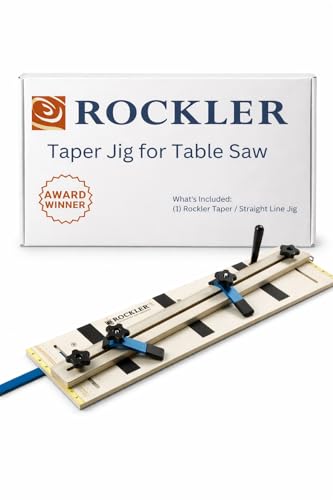 Rockler Taper Jig & Straight Line Wood Cutting31.6 x 7.75 inches7.87 x 36.22 x 1.18 Inches6.7 PoundsCheck on Amazon
 POWERTEC 71395 Taper/Straight Line Jig for Table Saws32"40.55 x 8.66 x 2.36 inches8.82 PoundsCheck on Amazon

What's inside
- What Actually Matters: Hold-Down Security and Angle Repeatability
- 1. MICROJIG TJ-5000 Microdial Tapering Jig — The Dial-Set Precision Pick
- 2. Rockler Taper Jig and Straight Line Jig — The Long Sled Pick
- 3. POWERTEC 71395 Taper and Straight Line Jig — The Full Kit Pick
- 4. POWERTEC 71035V Tapering Jig — The Hinged Rail Pick
- 5. Peachtree Mini Taper Jig — The Small Parts Pick
- Which Taper Jig Should You Choose?
As an Amazon Associate I earn from qualifying purchases. This post may contain affiliate links at no extra cost to you.
A tapered leg is a long, angled rip cut made on a narrow blank, and that combination is exactly what a table saw handles worst without help. The blank wants to wander, the offcut side gets thinner as the cut runs, and your hands end up working close to the blade. A taper jig solves the geometry and the safety problem at once: it holds the leg at a set angle, carries it through the cut on a straight reference edge or miter bar, and gives your hands a handle or a push block to ride on instead of the workpiece itself.
Disclosure: As an Amazon Associate, I earn from qualifying purchases. Product details were verified at the time of writing.
This guide covers taper jigs you buy ready to use. It does not cover crosscut sleds, which square and miter the ends of boards rather than rip a long taper — those have their own guide on this site. It also leaves out shop-made tapering jigs: the site carries a beginner build guide for making your own, and a bought jig is the right answer when you want indexed settings and hold-downs that work the same way on the first leg and the fourth.
Contents
- What Actually Matters: Hold-Down Security and Angle Repeatability
- 1. MICROJIG TJ-5000 Microdial Tapering Jig — The Dial-Set Precision Pick
- 2. Rockler Taper Jig and Straight Line Jig — The Long Sled Pick
- 3. POWERTEC 71395 Taper and Straight Line Jig — The Full Kit Pick
- 4. POWERTEC 71035V Tapering Jig — The Hinged Rail Pick
- 5. Peachtree Mini Taper Jig — The Small Parts Pick
- Which Taper Jig Should You Choose?
What Actually Matters: Hold-Down Security and Angle Repeatability
Hold-down security comes first, because the jig’s whole job is keeping the leg captive near the blade. A leg blank that shifts mid-cut can bind against the blade, kick back, or simply ruin the taper. The five jigs below hold stock three different ways, and the difference matters. Sled-style jigs clamp the blank down to a base with toggle-style hold-downs, so the leg cannot lift, twist, or creep. Hinged rail jigs pin the blank between two rails and a stop, and lean on the rip fence for support — workable, but the blank is held by pressure and position rather than a clamp. The Microdial design takes a third route: the jig sets the angle and a push block riding on top supplies the downward and forward hold. Whichever style you pick, the honest rule is the same: if you cannot wiggle the blank by hand once it is set, the jig is doing its job. If you can, stop and fix the setup before the saw starts.
Angle repeatability is the second criterion, because legs come in sets of four. A jig earns its keep when leg two, three, and four come out identical to leg one without re-measuring. Indexed holes, etched scales, dial stops, and memory locks are all ways of making the angle a setting instead of a measurement. Dials and memory stops are the fastest to return to; etched scales are close behind; simple index marks work fine when you cut all four legs in one session at one setting.
Check the fit before anything else. Sled-style jigs ride in a standard 3/4 by 3/8 inch miter slot, but the distance from that slot to the blade varies between saws, and each sled maker states the range it fits. Hinged rail jigs need a rip fence that locks parallel and a table long enough for the rails. Measure your saw first; a jig that does not fit your slot position will never cut a clean taper no matter how good its scale is.
Work safely, in plain terms. Set the angle and clamps with the saw off. Make a test cut on scrap the same thickness as your leg blank and check the taper against your layout lines before touching the real stock. Keep both hands on the handle or push block for the whole cut, never reach across the blade to catch the offcut, and let the cut finish before you pull the jig back. Taper the wide faces first on a four-sided leg, and keep the blade guard in place wherever the jig design allows it.
1. MICROJIG TJ-5000 Microdial Tapering Jig — The Dial-Set Precision Pick

The Microdial takes a completely different approach from every sled on this list. Instead of a base and clamps, it is a pair of dial-set guides that attach to GRR-RIPPER 3D Pushblocks, and the push blocks become the hold-down: they press the leg down and forward while your hands ride on top, well above and behind the blade. The angle comes from two ColorMatch dials — one reads in degrees, the other in rise over run — so you can set a taper the way your plans state it, either as an angle or as inches per foot.
Two MemoryLock stops hold two different angles at once, which is the feature that matters most on real furniture work: a leg tapered on two adjacent faces often needs the same setting four times over, and a leg with a different taper on the second pair of faces needs two settings that alternate. Dial the first angle, lock it, dial the second, lock it, and switch between them all afternoon without measuring again. The same jig also works on a router table and a band saw, and it can cut legs with two, four, six, or eight tapered sides.
The honest limit: the jig on its own is the angle guide. The holding power comes from the push blocks, which are a separate purchase if you do not already own them, and the system suits leg-sized stock rather than wide panels. For repeatable angles on furniture legs, nothing else on this list sets and resets as fast.
Specs
- Brand: MICROJIG
- Model: TJ-5000 Microdial
- Angle range: 0 to 10 degrees, set in 1/8-degree steps
- Rise over run setting: 0 to 2 in per foot, in 1/16 in steps
- Angle memory: Two independent MemoryLock stops
- Hold-down method: GRR-RIPPER 3D Pushblocks (separate purchase) press down and forward
- Machine fit: Table saws, router tables, and band saws
- Work it handles: Legs with 2, 4, 6, or 8 tapered sides
2. Rockler Taper Jig and Straight Line Jig — The Long Sled Pick

Rockler’s jig is the classic sled pattern done carefully. A half-inch MDF base faced with low-friction laminate slides on a 36 inch miter bar, two wide hold-down clamps lock the blank to the base, and a large handle gives your pushing hand one clear place to be. The angle is set with an indexed system: holes along the fence line each stand for one degree of taper, so returning to a setting is a matter of counting holes rather than reading a scale.
The long bar and base are the point of this design. A full-length chair or table leg sits on the sled with support under nearly its whole length, the clamps hold it at both ends of the cut, and the base trims to a zero-clearance edge against your blade on first use, which shows you exactly where the cut will fall. Take the miter bar off and the same sled becomes a straight-line ripping jig that puts a clean first edge on a rough board — a second job most furniture shops need weekly.
Fit is the one thing to verify before ordering. The bar mounts in two positions to suit saws whose right miter slot sits 3-3/4 to 4-3/8 inches, or 5 to 5-5/8 inches, from the blade. If your saw falls outside those bands, pick one of the other sleds below instead.
Specs
- Brand: Rockler
- Base: 1/2 in MDF with low-friction laminate, 31-5/8 x 7-3/4 in
- Miter bar: 36 in, adjustable, two mounting positions
- Hold-down method: Two wide hold-down clamps on the base
- Angle setting: Indexed holes, one mark per degree
- Stock width: Tapers boards up to 6 in wide
- Saw fit: Right miter slot 3-3/4 to 4-3/8 in, or 5 to 5-5/8 in, from the blade
- Second job: Straight-line ripping with the miter bar removed
3. POWERTEC 71395 Taper and Straight Line Jig — The Full Kit Pick
The 71395 follows the same sled pattern as the Rockler — melamine-coated MDF base, 36 inch miter bar, hold-down clamps — and ships as a complete kit rather than a bare jig. Alongside the clamps you get abrasive grip strips that bond to the base and bite the underside of the blank, an adjustable fence with a stop plate, a push knob, and the small hardware and measuring tape the assembly calls for. The grip strips are worth singling out: clamps hold a leg down, but the strips stop it sliding along the base as the blade starts the cut, which is the moment a blank is most likely to creep.
The fence and stop plate give this sled its repeatability. Set the angle on the fence once, butt each leg blank against the stop, clamp, and cut; the four legs of a table come off the saw as a matched set. The base dimensions are a touch wider than the Rockler’s, which helps on stool and bench legs, and like the Rockler it converts to straight-line ripping for a first clean edge on rough stock.
The fit range is the same style of check: the maker lists three slot-to-blade bands, and full-size saws with a standard 3/4 by 3/8 inch slot are the target. Small jobsite saws with non-standard slots are not.
Specs
- Brand: POWERTEC
- Model: 71395
- Base: 32 x 7-7/8 x 1/2 in MDF with melamine coating
- Miter bar: 36 in aluminum
- Hold-down method: Hold-down clamps plus abrasive grip strips
- Angle setting: Adjustable fence with stop plate
- Kit contents: Miter bar, fence, push knob, clamps, grip strips, tape measure, T-bolts, hardware, mini screwdriver
- Miter slot fit: Standard 3/4 x 3/8 in slots on full-size table saws
- Second job: Straight-line ripping
4. POWERTEC 71035V Tapering Jig — The Hinged Rail Pick
The 71035V is the older, simpler taper jig pattern made well: two 24 inch extruded aluminum rails joined by a steel hinge, with a laser-etched scale along one rail, work stops, a lock knob, and a handle. There is no base and no miter bar. The rails open to the angle you set, the assembly rides against your rip fence, and the blank sits in the V of the rails against the stops while you feed the whole thing through with a push block.
The etched scale reads the taper directly in the terms leg work uses: from 1 inch per foot, about 4.8 degrees, up to 3 inches per foot, about 15 degrees — a wider range than any sled here, which makes this the pick for strongly tapered legs on stools, plant stands, and sawbenches. Aluminum rails stay straight, shrug off glue and damp shop air, and the whole jig hangs on a nail when the job is done.
Be clear-eyed about the hold-down story, because this pattern has the least of it. Nothing clamps the blank. The stops keep it from sliding forward, the rail keeps it from sliding sideways, and your push block keeps it down. That works well on long, straight blanks fed at a steady pace, and it is the wrong tool for short or narrow stock, which belongs on a clamping sled or the mini jig below.
Specs
- Brand: POWERTEC
- Model: 71035V
- Rails: 24 in extruded aluminum, anodized finish
- Hinge: Steel, with lock knob
- Angle scale: Laser-etched, 1 in per foot (4.8 degrees) to 3 in per foot (15 degrees)
- Hold-down method: Work stops and rail pressure, fed with a push block (no clamps)
- Guide reference: Rides against the rip fence
- Parts included: Work stops, ergonomic handle, lock knob
5. Peachtree Mini Taper Jig — The Small Parts Pick
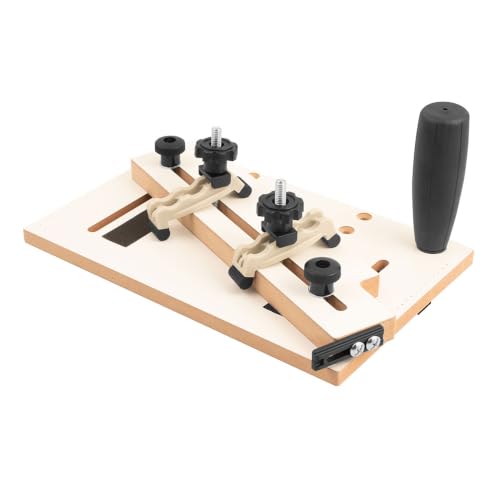
Most taper jigs are built around chair and table legs, and most are clumsy on anything shorter. The Peachtree Mini is the sled pattern shrunk to bench scale: an 11-1/2 inch melamine-coated MDF base on a standard miter bar, with two hold downs, anti-slip grip strips, and an adjustable stop, sized for the short tapers on box feet, small table legs, model work, and craft parts.
The detail that earns it a place here is the adjustable stop. On a mini sled the workpiece sits close to the blade by design, and the composite stop sets the cut position while keeping the jig body itself out of the blade’s path, so repeated small parts come out the same size without the base getting chewed up. The large knobs are easy to set with cold or gloved hands, and the whole jig stores in a drawer.
The limits are printed in its dimensions: stock up to 2-1/4 inches tall and blanks that fit an 11-1/2 inch base. Full-size furniture legs belong on the sleds above. Within its size class, this is the one jig here that treats small parts as the main job rather than an afterthought.
Specs
- Brand: Peachtree Woodworking Supply
- Base: 7-1/4 x 11-1/2 x 1/2 in melamine-coated MDF
- Miter bar: 3/4 x 3/8 in, standard size
- Hold-down method: Two hold downs plus anti-slip grip strips
- Angle setting: Adjustable composite stop
- Stock limit: Up to 2-1/4 in tall
- Machine fit: Most table saws with standard miter slots
- Best work: Short legs, box feet, small and detailed parts
Which Taper Jig Should You Choose?
Match the jig to the hold-down style you trust and the legs you actually cut. If you set tapers from plans written two different ways and switch angles often, the Microdial’s twin dials and memory stops remove the measuring from the job — just budget for the push blocks that complete its hold-down system. If you cut full-length furniture legs and want clamps, a long supported base, and one jig that also straightens rough boards, the Rockler sled is the straightforward answer, with the POWERTEC 71395 matching it feature for feature and adding grip strips and a fuller kit in the box. If your tapers run steep and your blanks run long and straight, the hinged POWERTEC 71035V gives you the widest angle range in the simplest, lightest package. And if your tapers live on small parts, the Peachtree Mini is the only pick here built for that scale.
Whichever one lands on your saw, run the same first session: set it up with the saw off, clamp or seat a scrap blank, make the cut, and measure both ends against your layout. A taper jig that repeats that scrap result four times in a row will give you four legs that stand level — and that, more than any scale or dial, is what the tool is for.
FAQ
Which Taper Jig Should You Choose?
Related guides
More from Amazon
Programs that pair well with the guide above. Offers and eligibility are set by Amazon and may change.
A free business account with business pricing and bulk-buying tools for work, shop or home office.
Create a business accountFree shipping on eligible items, Prime Video and more. Eligible new members can start with a free trial.
Start a Prime free trialAudiobooks and podcasts to listen to on the go. Eligible new members can start with a free trial.
Try Audible freeAd-free music streaming. Eligible new subscribers can start with a free trial.
Try Music Unlimited freeAs an Amazon Associate we earn from qualifying purchases.








