What's inside
- Contents
- Why choose a stand instead of trees or posts
- Main types of hammock stands
- Matching stand length to hammock length
- Understanding weight capacity
- Frame materials and finishes
- Stability, ground and placement
- Thinking about building your own
- Safety notes
- Buyer checklist
- Mistakes to avoid
- Frequently asked questions
- Bottom line
As an Amazon Associate I earn from qualifying purchases. This post may contain affiliate links at no extra cost to you.
The short answer: the best hammock stand is the one that matches your hammock’s length, carries your combined weight with a generous margin, sits level on the ground you actually have, and does not tip when someone climbs in or out. Steel stands suit most backyards because they are strong and weather-tolerant. Wood stands look beautiful but need more care. Portable folding stands trade some rigidity for easy storage and travel. Space-saving designs work for small patios, though they often pair with shorter hammocks. Start with the length and weight numbers, then work outward.
This guide does not rank products. It explains the stand types, how stand length relates to hammock length, what capacity ratings do and do not tell you, how to choose a stable footprint, and what to check before you trust your weight to a frame. It also covers practical points for woodworkers who are tempted to build their own. Compare the ideas here with current listings and the maker’s instructions for any model you consider.
Contents
- Contents
- Why choose a stand instead of trees or posts
- Main types of hammock stands
- Matching stand length to hammock length
- Understanding weight capacity
- Frame materials and finishes
- Stability, ground and placement
- Thinking about building your own
- Safety notes
- Buyer checklist
- Mistakes to avoid
- Frequently asked questions
- Bottom line
Our Top Picks
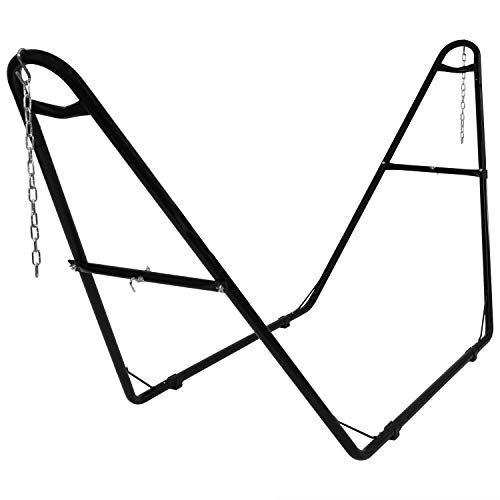 Sunnydaze Universal Heavy-Duty Hammock Stand for Outside124" x 40" x 52.5"124 x 52.5 x 40 inches33 PoundsCheck on Amazon

Contents
- Why choose a stand instead of trees or posts
- Main types of hammock stands
- Matching stand length to hammock length
- Understanding weight capacity
- Frame materials and finishes
- Stability, ground and placement
- Thinking about building your own
- Safety notes
- Buyer checklist
- Mistakes to avoid
- Frequently asked questions
- Bottom line
Why choose a stand instead of trees or posts
Two healthy trees at the right distance are a lovely hammock support, but few yards offer them. Trees also move, grow, drop limbs and can be harmed by straps cinched too tightly. Fixed posts require digging and concrete and are hard to change later. A stand gives you a self-contained support you can place on a patio, lawn or deck, move for mowing and take with you if you relocate.
The trade-off is that a stand has to be strong and wide enough to resist the pulling forces a hammock creates. When you lie in a hammock, the ends pull inward on the frame, and the frame must manage that pull through its base. Good design handles it quietly. Poor design wobbles, tips or bends.
Main types of hammock stands
The category covers several quite different products. The table summarises general traits so you can decide which family fits your space before you compare details.
| Stand type | General strengths | General drawbacks | Good fit for |
|---|---|---|---|
| Arc or curved steel stand | Strong shape, often accommodates long hammocks, sturdy base | Large footprint, can be heavy to move, assembly takes time | Backyards, lawns, permanent garden spots |
| Straight-bar or trestle steel stand | Simple design, usually straightforward to assemble | Needs wide feet for stability, may look plain | Patios and general use |
| Wooden stand | Warm look, blends into gardens, can be refinished | Needs sealing, heavier, joints may loosen over time | Decks, covered porches, decorative settings |
| Portable folding stand | Light, packs into a bag, quick to set up | Often lower rigidity, may suit shorter hammocks only | Camping, travel, occasional use |
| Space-saving or compact stand | Small footprint, fits balconies and patios | Limits hammock length, check capacity carefully | Apartments, small outdoor spaces |
| Combination stand with canopy or chair option | Extra shade or adjustable use | More parts, more weight, more to check | Sunny yards, flexible seating |
Arc stands
Arc frames curve upward at each end, which lets them support a hammock at a comfortable height while keeping the base low and wide. They are common in backyards because they usually take long hammocks. Check how the arc sections join, since joins are where wobble can appear.
Wooden stands
Wood stands suit gardeners who want the support to look like part of the landscape. Check the thickness of the timber, the type of joinery and whether the fasteners are corrosion-resistant. Because hammocks pull a frame inward, loose bolts or small joint surfaces cause trouble. Outdoors, wood needs a protective finish and occasional re-tightening of hardware.
Portable stands
A folding stand is easy to carry and store, which makes it attractive for campsites and beach trips. Remember that lightness often means thinner tubing and shorter spans. Read the stated length range for compatible hammocks, and treat the capacity as a firm limit, not a suggestion.
If flexibility matters most, compare a portable hammock stand against a heavier fixed frame, and think honestly about how often you will carry it.
Matching stand length to hammock length
This is the most common source of disappointment. A stand is built for a certain range of hammock lengths. Too short, and the hammock hangs too tight, creating a flat, uncomfortable lie and extra strain on the frame. Too long, and the hammock sags to the ground or the ends pull upward awkwardly.
Look for two numbers on the stand’s product page: the stand length or hook-to-hook distance, and the recommended hammock length. A common design approach is to choose a hammock a little longer than the distance between the stand’s hanging points, so there is enough slack for a gentle curve. Manufacturers state their own recommendations, and those should override any general rule.
Rope, chain and hardware
Some stands come with hanging chains or ropes, others expect your hammock’s own suspension. Check the hardware that attaches to the frame. Hooks should be closed or have a safety latch, and chain links and carabiners should be rated for load. Do not substitute lightweight craft hardware for rated components.
Spreader bars and fabric hammocks
Spreader-bar hammocks hold the fabric flat but are less stable for getting in and out, and the bars can make a hammock more prone to tipping. Gathered-end fabric hammocks usually sit lower in the middle and feel steadier. Check which style your stand supports, and whether the maker recommends one over the other.
Understanding weight capacity
A listed capacity tells you what the maker rates the stand to hold, but it does not tell you everything. Consider the following when you read it.
- Combined load: add the weight of everyone who may use the hammock at once, plus the hammock itself and any bedding or accessories.
- Dynamic loading: climbing in, swinging and children bouncing create momentary forces larger than static weight. Leave a margin well beyond your expected load.
- Hammock rating: the hammock has its own limit. The system is only as strong as the weakest component.
- Check the source: look for details about how the rating is derived and whether it relates to one person or the whole frame.
If you are near the upper end of a stand’s rating, move up to a sturdier model. Ratings are not a promise that a stand can be pushed to the limit on uneven ground or after years of weathering.
Frame materials and finishes
Steel
Powder-coated steel is the common choice for outdoor stands. Look for a finish that is thick and even, with sealed ends on tubes to stop water getting inside. Scratches expose bare metal, so touch up chips promptly with a suitable paint. Heavier tube walls resist bending, and the weld or bolt joints deserve a close look.
Aluminium
Aluminium stands are lighter and do not rust, which suits portable designs. They can be strong but typically use larger tubing to compensate, and the rated capacity may be lower than a comparable steel frame. Always follow the stated limits.
Wood and bamboo
Timber and bamboo bring natural warmth. Both need protection from prolonged moisture and sun, and joints should be checked every season. Bamboo can crack if allowed to dry out completely, so follow the maker’s care guidance.
Fasteners and feet
Look at the small parts: bolts, nuts, washers and end caps. Stainless or coated hardware lasts longer outdoors. Rubber or plastic feet protect decks and stop slipping, though feet on soft ground can sink, and a wider foot or a flat paver under each foot can help.
Stability, ground and placement
A stand is only as stable as the surface beneath it. Choose a spot that is flat, firm and clear of overhead hazards such as branches, wires or low roofs. Avoid slopes, soft wet lawn and loose gravel where feet can shift.
Footprint and tipping
The wider the base compared with the height, the more resistant a stand is to tipping. Check whether the base extends sideways as well as lengthwise. A long, narrow base can feel fine lying still but rock when you get in or out. Some stands include stabiliser bars or stakes. Follow the instructions for anchoring on lawns.
Decks and patios
On a deck, check the load limits of the boards and the structure beneath them. A hammock stand concentrates weight on four or six small points. Pads under the feet spread the load and protect the surface. On a balcony, check building rules and weight allowances before bringing in any large frame.
Wind and weather
Strong wind can push a stand or swing an occupied hammock into other objects. In stormy weather, take the hammock off the frame and consider stowing a lightweight stand. Hammocks left outdoors age quickly in sun and rain, so follow the fabric care instructions.
If you want extra shade over the stand, look at a hammock stand with a canopy, and confirm that the canopy is compatible and designed for wind.
Seasonal care and storage
At the end of the season, wipe the frame clean, let it dry completely and check for chips in the finish. Touch up bare metal, oil or reseal wood as the maker advises, and store the pieces somewhere dry. Keep fasteners together in a labelled bag so that reassembly in spring is quick and nothing is replaced with the wrong size. A few minutes of care here prevents most of the looseness and rust that owners complain about later.
Comfort accessories
Pillows, under-quilts and mosquito netting add comfort, but they also add weight and wind catch. Include them in your combined load estimate, and choose netting designed for hammock use so that it does not tangle the suspension.
Thinking about building your own
A hammock frame is an appealing project for woodworkers, but it carries a person above the ground, so it demands more caution than most garden projects. Consider the following before you start.
- Use sound, straight timber without large knots, splits or rot in load-bearing parts.
- Use bolts and structural hardware, not wood screws alone, at the main joints.
- Design a wide base and angled braces so that the frame resists the inward pull.
- Use rated hanging hardware and do not improvise with unrated parts.
- Test the build gradually with a low load close to the ground before anyone relies on it.
If you are not confident in the engineering, buying a stand with a published rating is a safer route. If you do build, a quality hammock stand hardware kit can supply hooks, chains and brackets designed for the job, though you should still verify the capacity and compatibility on the listing.
Safety notes
- Never exceed the stated capacity for the stand or the hammock, and remember it applies to the combined load.
- Inspect before each use: look for loose bolts, cracks, bent tubes, rust, worn rope and frayed fabric.
- Children: supervise them, and do not allow jumping, standing or multiple children piling in beyond the rated load.
- Entry and exit: sit in the centre first, then lie back. Standing in a hammock risks a fall.
- Surroundings: keep the area free of hard objects, fire pits, grills and sharp tools. Check overhead for dead limbs.
- Hammock position: avoid hanging a hammock so tight that it puts excess force on the frame.
- Assembly: follow the manual, tighten all fasteners, and recheck after the first few uses.
- Alcohol and fatigue: be cautious, since falling from a hammock can cause injury.
Buyer checklist
- Do I know my hammock’s length and weight limit?
- Does the stand state a compatible hammock length range?
- Is the combined capacity comfortably above everyone who may use it?
- Is the frame steel, aluminium or wood, and does that suit my weather?
- Is the finish protected against rust, with sealed tube ends?
- Does the base look wide enough for the height?
- Is the ground flat and firm where I plan to place it?
- Are hooks closed or latched, and are any chains rated?
- Can I assemble it alone, or do I need help?
- How will I store it in winter or bad weather?
- Have I read the latest reviews, return terms and manual?
Mistakes to avoid
Buying a stand and hammock separately without checking compatibility
Mismatched lengths cause sagging or strain. Confirm both numbers before you order either.
Trusting capacity without a margin
Swinging and entering add force. Pick a frame with room to spare and keep children from bouncing.
Ignoring the ground
Uneven or soft ground tilts the frame and stresses joints. Level the area and use pads under feet if needed.
Skipping assembly steps
Rushed assembly leaves bolts loose. Follow each step in order and recheck fasteners after early use.
Leaving everything out in all weather
Moisture and sun shorten the life of ropes, fabric and finishes. Store the hammock when it is not in use.
Using worn or unrated hardware
Replace frayed rope, rusted hooks and bent chain. Do not substitute household hardware for rated parts.
Frequently asked questions
How long should a hammock stand be?
It depends on your hammock. Check the maker’s recommended hammock length range and the distance between hanging points, and choose a stand designed for your hammock.
What weight capacity should I look for?
Add the weight of everyone who may use it together and choose a rating comfortably above that. Remember that movement increases force, and that the hammock has its own limit.
Are steel stands better than wooden ones?
Steel is usually easier to maintain outdoors, while wood looks more natural and needs more care. Quality of construction matters more than material alone.
Can I use a hammock stand on a deck?
Often yes, but check the load limits of the deck and use pads under the feet to spread the weight. Follow your deck builder’s or local guidance if you are unsure.
Will a portable stand hold an adult?
Some are rated for adults and some are not. Check the listing for the exact capacity and compatible hammock length, and follow it strictly.
Do I need to anchor my stand?
Some makers recommend stakes or weights on lawns or windy sites. Read the instructions for your model and follow them.
How do I stop a stand from tipping?
Use a flat, firm site, ensure the base is fully assembled, enter the hammock carefully through the centre and avoid hanging it too tight. Wide bases and stabiliser bars help.
Can I leave a hammock stand outside all year?
Some frames tolerate it, but sun, rain and frost shorten the life of finishes and fabric. Check the manufacturer’s guidance and store parts when practical.
Bottom line
The best hammock stand is stable, correctly sized for your hammock and rated with a clear safety margin. Match lengths, respect capacity, prepare a level site and inspect hardware regularly. Products and instructions change, so check current specifications and the manufacturer’s guidance before you buy and before each season of use. When you are ready to compare, browse a steel hammock stand alongside the other types above and measure each against the checklist.
Disclosure: As an Amazon Associate, we earn from qualifying purchases. Links marked as sponsored may earn us a commission at no extra cost to you.
Related guides
More from Amazon
Programs that pair well with the guide above. Offers and eligibility are set by Amazon and may change.
A free business account with business pricing and bulk-buying tools for work, shop or home office.
Create a business accountFree shipping on eligible items, Prime Video and more. Eligible new members can start with a free trial.
Start a Prime free trialAudiobooks and podcasts to listen to on the go. Eligible new members can start with a free trial.
Try Audible freeAd-free music streaming. Eligible new subscribers can start with a free trial.
Try Music Unlimited freeAs an Amazon Associate we earn from qualifying purchases.