
Key takeaways
- Compare abrasive cleaning sticks, checking stick size, material, grit renewal and handle for sanders, workshops, belt care and disc sanding.
What's inside
As an Amazon Associate I earn from qualifying purchases. This post may contain affiliate links at no extra cost to you.
A sanding belt or disc rarely wears out all at once. Long before the abrasive grain dulls, the surface loads up with sawdust, pitch, resin and glue residue until it stops cutting and starts burnishing the wood. An abrasive cleaning stick solves that problem in seconds. It is a solid block of natural crepe rubber that you hold against a running belt, disc or drum; the rubber grabs the packed debris, rolls it out of the grain and exposes fresh cutting edges again. Used regularly, one stick can stretch the working life of belts and discs several times over, which makes it one of the cheapest consumables in the whole workshop to keep on hand.
Disclosure: As an Amazon Associate, I earn from qualifying purchases. Product details were verified at the time of writing.
This guide compares five cleaning sticks that cover the main buying patterns: a full-size single stick for a bench sander, square-profile sticks for belts and discs, a two-pack for shops that clean abrasives all day, and a set of short sticks that suit small discs and detail sanders. Every pick below is natural rubber, because that material is what makes the cleaning action work.
Contents
How to Choose an Abrasive Cleaning Stick
Stick size and cross-section. Length is your safety margin. A longer stick keeps your fingers further from a moving belt and gives you two hands worth of grip on wide drum sanders. Cross-section matters too: a chunky 1-1/2 inch square face covers a wide belt quickly, while a slimmer stick is easier to steer across a small disc or a spindle sleeve.
Material. Genuine cleaning sticks are made from natural crepe rubber. The soft, tacky rubber deforms around the abrasive grains, grips the clogged dust and pitch, and pulls it free as it passes. Synthetic erasers and household rubber blocks do not behave the same way and tend to smear residue instead of lifting it, so check that the listing states natural rubber.
How grit renewal works. A cleaning stick does not sharpen abrasive grain and it cannot restore a belt that is genuinely worn smooth. What it does is remove loading — the packed material between the grains — so the existing sharp edges can cut again. It works best on dry, cured residue. Wet glue, uncured finish and melted plastic need to be dealt with differently, and a stick should never be used on a conveyor-feed sander where it can be pulled into the machine.
Handle and grip. Most sticks are plain rubber bars you hold directly, and as the rubber wears down you simply keep using the shorter stick. Some woodworkers mount a stick in a wooden handle or holder to extend reach and keep a consistent grip. If you clean wide belts daily, a longer stick effectively acts as its own handle; for small discs, a short stick plus a simple shop-made holder gives the best control.
Pack size. A single full-size stick lasts a hobby shop a long time, because only a thin layer of rubber is consumed per cleaning. Production shops, and anyone running a drum sander, go through them faster and are better served by multi-packs or longer sticks that can be cut down as they wear.
The 5 Best Abrasive Cleaning Sticks
1. POWERTEC 71002 Abrasive Cleaning Stick, 8-1/2 Inch
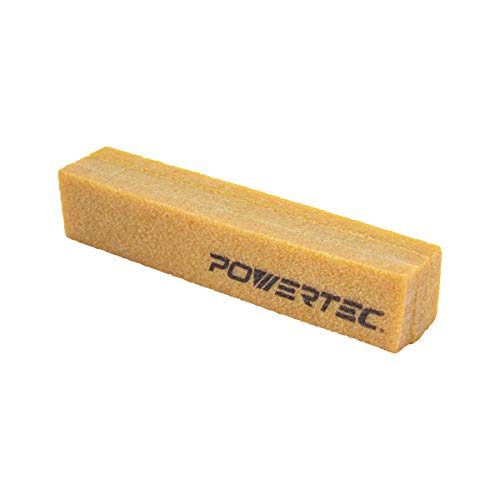
The 71002 is the reference design most other sticks are measured against. It is a single bar of professional-grade natural rubber, long enough to span the width of common bench belts while keeping your hand well clear of the abrasive. Press it lightly against a running belt or disc and the loaded dust and gum roll off in ribbons, leaving the grain cutting like new. It suits belt sanders, disc sanders and drum sanders, and the generous length means it stays useful for years of regular cleaning in a home shop.
Specs
- Material: Natural rubber
- Dimensions: 8.4 x 1.5 x 1.5 in
- Weight: 10.6 oz
- Model: 71002
- Quantity: 1 stick
- Works on: Sanding belts, discs and drums
2. abrasticle Abrasive Cleaning Eraser Stick, 8 Inch

The abrasticle stick uses the classic square profile: 1-1/2 inches on each side and 8 inches long. That square face sits flat and stable against a belt, which makes it easy to apply even pressure without the stick rocking or twisting in your hand. It is a straightforward, single-stick option for woodworkers who mostly clean 4-inch belts and 6-inch discs, and the natural rubber compound handles sawdust, pitch and resin loading the way a cleaning stick should.
Specs
- Material: Natural rubber
- Dimensions: 1.5 x 1.5 x 8 in
- Model: Abrasive Cleaning Eraser Stick
- Quantity: 1 stick
- Works on: Sanding belts, discs and sandpaper
3. TPmax Abrasive Cleaning Eraser Stick, 200 mm

TPmax sells its stick in metric sizing — 40 x 40 x 200 mm, roughly 1.6 inches square and just under 8 inches long — which gives it a slightly fatter face than most square sticks. That extra contact area is handy on wide belts and larger discs, where fewer passes are needed to clear the whole surface. The stick is solid natural rubber from end to end, so as one face wears or glazes you can rotate to a fresh side and keep going.
Specs
- Material: Natural rubber
- Dimensions: 40 x 40 x 200 mm (about 1.6 x 1.6 x 7.9 in)
- Quantity: 1 stick
- Works on: Sanding belts, discs and sandpaper
4. Peachtree Woodworking Supply Abrasive Cleaning Stick, 2 Pack

Peachtree Woodworking Supply is a specialist woodworking retailer, and its cleaning stick comes as a two-pack of the standard 1-1/2 x 1-1/2 x 8 inch size. Two sticks make practical sense if you run more than one sander: keep one at the belt and disc station and one near the drum sander, instead of carrying a single stick around the shop. The natural rubber lifts dust, pitch and gum from belts and discs, and having a spare also means you can cut one down for a holder while keeping the other full length.
Specs
- Material: Natural rubber
- Dimensions: 1.5 x 1.5 x 8 in per stick
- Quantity: 2 sticks
- Works on: Sanding belts, discs and sandpaper
5. POWERTEC 71424-P2 Abrasive Cleaning Stick, 4-1/2 Inch, 4 Pack

Not every abrasive needs a full-size stick. The 71424-P2 set contains four sticks at 4-1/2 inches long, a handier size for small sanding discs, detail sanders and narrow belts where a long bar is awkward to control. The shorter length also makes these a sensible choice to dedicate to individual machines around the shop. They are the same natural rubber formula as POWERTEC’s larger sticks, in a compact format that is easy to store in a drawer beside each sander.
Specs
- Material: Natural rubber
- Stick length: 4.5 in
- Model: 71424-P2
- Quantity: 4 sticks
- Works on: Sanding belts, discs and sandpaper
Comparison Table
| Product | Stick size | Material | Quantity | Best suited for |
|---|---|---|---|---|
| POWERTEC 71002 | 8.4 x 1.5 x 1.5 in | Natural rubber | 1 | Belts, discs and drums |
| abrasticle Eraser Stick | 1.5 x 1.5 x 8 in | Natural rubber | 1 | Everyday belt and disc cleaning |
| TPmax Eraser Stick | 40 x 40 x 200 mm | Natural rubber | 1 | Wide belts and larger discs |
| Peachtree Woodworking 2 Pack | 1.5 x 1.5 x 8 in | Natural rubber | 2 | Multi-sander shops |
| POWERTEC 71424-P2 | 4.5 in length | Natural rubber | 4 | Small discs and detail sanders |
FAQ
How do you use a cleaning stick safely? Start the sander, then hold the stick flat against the moving abrasive with light, even pressure and let the rubber do the work. Keep a firm two-handed grip, work from the side of the belt rather than reaching over it, and never use a stick on a conveyor-feed machine.
Can a cleaning stick save a worn-out belt? No. It removes loading — packed dust, pitch and resin — so sharp grain can cut again. If the grain itself is dull or torn, the belt needs replacing no matter how clean it is.
How often should you clean a belt or disc? Whenever cutting slows, the surface looks glazed, or the wood starts showing burn marks. A quick pass every few workpieces on resinous timber keeps loading from building up in the first place.
Does the stick wear out? Yes, slowly. A thin layer of rubber is consumed with each cleaning, and the stick gradually gets shorter. Rotate it to use all faces evenly, and trim a glazed end if one develops.
Verdict
For most workshops, the POWERTEC 71002 is the stick to buy first: full-size, proven and long enough for safe use on belts and drums alike. The Peachtree two-pack suits anyone running several sanders, the TPmax and abrasticle sticks cover the standard square format at a slightly different feel, and the POWERTEC 71424-P2 four-pack fills the small-disc niche the big sticks handle poorly. Whichever you choose, the habit matters more than the brand — clean the abrasive while it is merely loaded, and your belts and discs will cut far longer.
Related guides
More from Amazon
Programs that pair well with the guide above. Offers and eligibility are set by Amazon and may change.
A free business account with business pricing and bulk-buying tools for work, shop or home office.
Create a business accountFree shipping on eligible items, Prime Video and more. Eligible new members can start with a free trial.
Start a Prime free trialAudiobooks and podcasts to listen to on the go. Eligible new members can start with a free trial.
Try Audible freeAd-free music streaming. Eligible new subscribers can start with a free trial.
Try Music Unlimited freeAs an Amazon Associate we earn from qualifying purchases.








