
Key takeaways
- Find the best hollowing tools with rigid bar picks, swivel tip designs, and sturdy handle builds for deep bowls and closed hollow form turning.
As an Amazon Associate I earn from qualifying purchases. This post may contain affiliate links at no extra cost to you.
Hollowing is the part of turning you do blind. Once a vessel’s opening narrows, the cutter disappears inside the form and the work runs on sound, feel and the shavings coming out of the mouth of the piece. The tool that does that work is not a bowl gouge with a longer handle: a bowl gouge cuts with an open flute and a rubbing bevel on surfaces you can see, while a hollowing tool is a stiff bar carrying a small cutter — a swivelling high speed steel tip or a round carbide disc — out past the tool rest and under the shoulder of a closed form. That difference in shape is why a dedicated hollower reaches places a gouge simply cannot follow.
Disclosure: As an Amazon Associate, I earn from qualifying purchases. Product details were verified at the time of writing.
This guide compares five hollowing tools that cover the main ways turners actually buy them: the classic flat-bottom swivel tip tool, a square-bar carbide hollower, a three-piece mini set for small vessels, an unhandled flat-back carbide tool, and a multi-tip system that swaps cutters on one shank. All five are freehand bars that ride on a standard tool rest. Captured rigs and articulated-arm systems with laser pointers exist for very deep work, but they are complete lathe-mounted systems rather than hand tools, so they sit outside this comparison — the honest line is that every tool below is guided by your hands, and wall thickness is checked with calipers and depth gauges, not read off a laser dot. Parting tools and skew chisels appear in other guides on this site; neither can undercut a shoulder inside a closed form, which is the whole job here.
How to Choose a Hollowing Tool
Bar rigidity decides how deep you can work
Every inch of bar hanging past the tool rest multiplies the leverage a catch can apply, and a bar that flexes turns that leverage into chatter. Cross-section is the first thing to read in a spec list. A 3/4 inch flat-bottom shank is the traditional answer: the wide flat underside sits planted on the rest and resists the rolling torque that tries to spin the tool in your hands. Square bars around 1/2 inch take the same approach in carbide tools, presenting a flat face to the rest instead of a round surface. Slimmer bars and mini tools trade that stiffness for access through small openings, which is the right trade for miniature work and the wrong one for a deep vase. Match the bar to the depth and opening of the forms you actually turn.
Pick a cutter type you can maintain
Two cutter families dominate. High speed steel tips, as fitted to the Sorby tools below, are small cutters you sharpen yourself with a diamond hone or a light touch on the grinder. They cut fast, can be honed to a fine burr for finishing passes, and ask for a sharpening habit in return. Carbide discs work differently: the round cutter is indexed by loosening one screw and rotating to a fresh section of edge, and replaced outright when the full circle dulls. There is nothing to sharpen, the edge geometry never changes, and negative rake versions tame resin, acrylic and cranky end grain. Neither family is better in the abstract — the real question is whether you would rather hone little and often, or rotate a disc and keep turning.
Neck shape follows the form
A straight bar bores the centre and removes the bulk from an open bowl or the middle of a vessel. Reaching under a shoulder — the inside curve below a narrow mouth — needs the cutter offset from the bar’s line, which is what swan neck and curved tools provide. Swivel tips split the difference: the cutter head rotates on the end of a straight bar, so one tool can present its edge at several angles. Sets that bundle a straight tool with one or two swan necks cover the full sequence of a hollow form in order, which is why the three-piece sets keep appearing in workshops.
You cannot see the wall, so plan how you will measure it
With the cutter hidden inside the form, thickness control comes from outside measurement. Double-ended calipers reach through the opening to read wall thickness directly, a depth gauge or a marked drill bit confirms the floor, and many turners work to a drilled depth hole set before hollowing starts. Laser-guided captured systems automate part of this by projecting the cutter position onto the outside wall, but on a freehand bar the discipline is manual: stop often, clear the shavings, and measure. Choose your measuring tools with the same care as the hollower itself.
Handle length is leverage, not comfort alone
A long handle spreads your hands and gives the rear hand the authority to resist a catch at depth. Full-size hollowers run 22 inches or more overall for exactly this reason. Mini tools shorten everything for small lathes and small work, where a long handle would be clumsy. Unhandled tools are a third route: the bar drops into an interchangeable handle you already own, which suits turners standardising on one handle system across many tools.
The 5 Best Hollowing Tools
1. Robert Sorby Hollowmaster, Full-Sized — The Classic Swivel Tip Hollower

The Hollowmaster is the tool most turners picture when hollowing comes up, and its design explains why. The 3/4 inch shank is machined flat on its underside, so it lies on the tool rest like a sled instead of a rolling pin; when a catch tries to twist the tool, that flat face is what pushes back. At the working end, a high speed steel hollowing tip sits in a swivelling head, letting you angle the cutter to follow the inside wall and undercut a shoulder without changing tools. A second tip, a full round scraper, swaps in for the finishing passes that clean up the interior surface. Both tips are sharpened with a diamond hone, and the head is chunky enough that the tool wants an opening of about an inch to work through — a fair trade for the control it gives on medium and larger vessels, in end grain and across bowl interiors alike.
Specs
- Bar: 3/4 in flat-bottom shank, high speed steel
- Cutters: Swivelling hollowing tip and full round scraper tip, interchangeable
- Sharpening: Diamond hone, tips resharpened in place
- Handle: Ash handle, about 24 in overall length
- Best for: Medium to large vessels and deep bowls
2. Easy Wood Tools Mid-Size Easy Hollower #1 (6601) — The Square-Bar Carbide Starter

Easy Wood Tools built its hollowing line around one idea: replace sharpening with a rotating disc. The #1 Hollower carries a Ci5 round carbide cutter on a straight 1/2 inch square stainless steel bar, CNC machined on every face but the bottom, so the bar registers flat on the rest and tracks straight as it bores the centre and clears the bulk from a vessel. Straight is the point of the #1 — it is the first tool in the maker’s three-stage sequence, with curved stablemates following for the walls and the rim. The maple handle runs 14 inches and the tool reaches 22-1/2 inches overall, enough leverage for mid-size forms on a full-size lathe. When the edge dulls you rotate the disc to a fresh section; an optional negative rake version of the cutter handles resin and difficult hardwoods. Vessels in the 3-1/2 to 4-1/2 inch depth range are its home ground.
Specs
- Bar: 1/2 in square stainless steel bar, flat bottom
- Cutter: Ci5 round carbide disc, 3/8 in diameter, rotatable and replaceable
- Handle: 14 in maple handle, 22-1/2 in overall length
- Neck: Straight, for centre boring and bulk removal
- Made in: USA
3. PSI Woodworking LCHOL3C Mini Hollowing Set — Three Angles for Small Vessels

Small hollow forms — lidded boxes, goblets, little vases — punish full-size tools: the bars are too thick for the openings and the handles too long for the scale. This three-piece set is built at the other end of the range. Each tool pairs a 10 inch wooden handle with a 5 inch blade for 15 inches overall, and the three blades cover the hollowing sequence in miniature: a straight tool to open the centre, a medium-angle swan neck for the walls, and a steep-angle swan neck to get under the rim. The cutters are replaceable 6mm carbide tips, so maintenance is a screwdriver job rather than a sharpening session. The set arrives in a wooden storage case with a hex wrench included. For turners whose hollow work is measured in inches rather than feet, this is the proportionate way in.
Specs
- Set contents: Straight, medium-angle swan neck and steep-angle swan neck tools
- Cutters: Replaceable 6mm carbide tips
- Dimensions: 10 in handles, 5 in blades, 15 in overall
- Included: Wooden storage case and hex wrench
- Best for: Mini and midi lathes, small vessels and lidded boxes
4. Simple Woodturning Tools Simple Turner & Hollower — The Flat-Back Unhandled Option
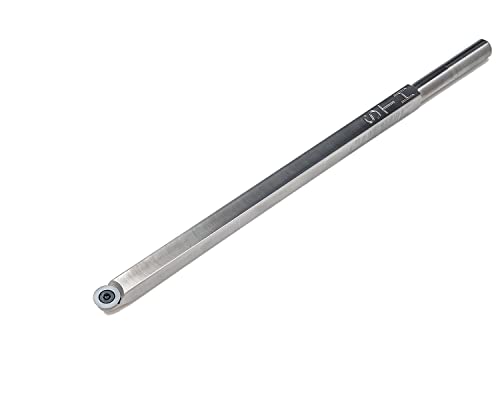
Harrison Specialties machines its tools in Minnesota around a flat-back shaft: instead of a round bar that can roll on the rest, the shaft presents a flat face that stays registered and level through the cut, which makes its behaviour predictable at the bottom of a vessel where you cannot watch the edge. The Turner & Hollower mounts a 9/16 inch round flat-top carbide cutter, sized to pull double duty — it shapes the outside of a form and then hollows the inside, so one tool covers a small project’s whole arc. It is sold unhandled, as a tool only: it drops into the maker’s handle system or a shop-made handle, which keeps the rack compact for turners who swap one handle across many bars. A screw and star wrench for the cutter come in the box. As a first carbide hollower for a turner already invested in interchangeable handles, it is a deliberately simple answer.
Specs
- Cutter: 9/16 in round flat-top carbide cutter, replaceable
- Shaft: Flat-back profile for level tool rest contact
- Format: Unhandled tool only, fits the maker’s handle system
- Included: Mounting screw and star wrench
- Made in: Minnesota, USA
5. Robert Sorby RS200KT Multi Tip Hollowing Tool — One Shank, Many Cutters

The Multi Tip takes the opposite route from a fixed-cutter tool: a single straight high speed steel shank accepts a family of interchangeable tips, so the same handle and bar become a hollower, then a shear scraper, then a detail cutter as the tips are swapped. The kit includes a shear scraper tip alongside the hollowing tips — the shear scraper is the finishing specialist, presenting its edge at a slicing angle that cleans up torn end grain inside a vessel better than a conventional scraping pass. Because every tip is high speed steel, the whole set is maintained with a hone and grinder you likely already own, and worn tips are replaced individually rather than retiring the tool. Turners who hollow a wide mix of forms, from open bowls to narrow-necked vessels, get the most from this approach: the versatility lives in the tip box, not in a rack of separate tools.
Specs
- Bar: Straight high speed steel shank
- Tips: Interchangeable hollowing tips, shear scraper tip included
- Sharpening: Hone or grinder, tips resharpened individually
- System: Additional tips available to extend the one tool
- Best for: Varied hollow forms and interior finishing work
Verdict
Start with the cutter system you will actually maintain. Turners happy to hone steel should take the Sorby Hollowmaster: its flat-bottom shank and swivelling tip remain the benchmark freehand design for medium and large vessels. Turners who would rather rotate a disc than sharpen should take the Easy Wood Tools #1 Hollower, whose square bar and Ci5 carbide cutter make the first stage of hollowing almost mechanical. Small work belongs to the PSI mini set, whose three angles are honestly scaled to the vessels they serve. The Simple Turner & Hollower suits handle-system users who want one flat-back tool for outside and inside work, and the Sorby Multi Tip is the pick for turners whose forms vary enough to justify a box of tips. Whichever bar you choose, keep the overhang past the rest as short as the work allows, measure the walls more often than feels necessary, and let the cutter — not your shoulders — do the work.
Related guides
More from Amazon
Programs that pair well with the guide above. Offers and eligibility are set by Amazon and may change.
A free business account with business pricing and bulk-buying tools for work, shop or home office.
Create a business accountFree shipping on eligible items, Prime Video and more. Eligible new members can start with a free trial.
Start a Prime free trialAudiobooks and podcasts to listen to on the go. Eligible new members can start with a free trial.
Try Audible freeAd-free music streaming. Eligible new subscribers can start with a free trial.
Try Music Unlimited freeAs an Amazon Associate we earn from qualifying purchases.








