What's inside
As an Amazon Associate I earn from qualifying purchases. This post may contain affiliate links at no extra cost to you.
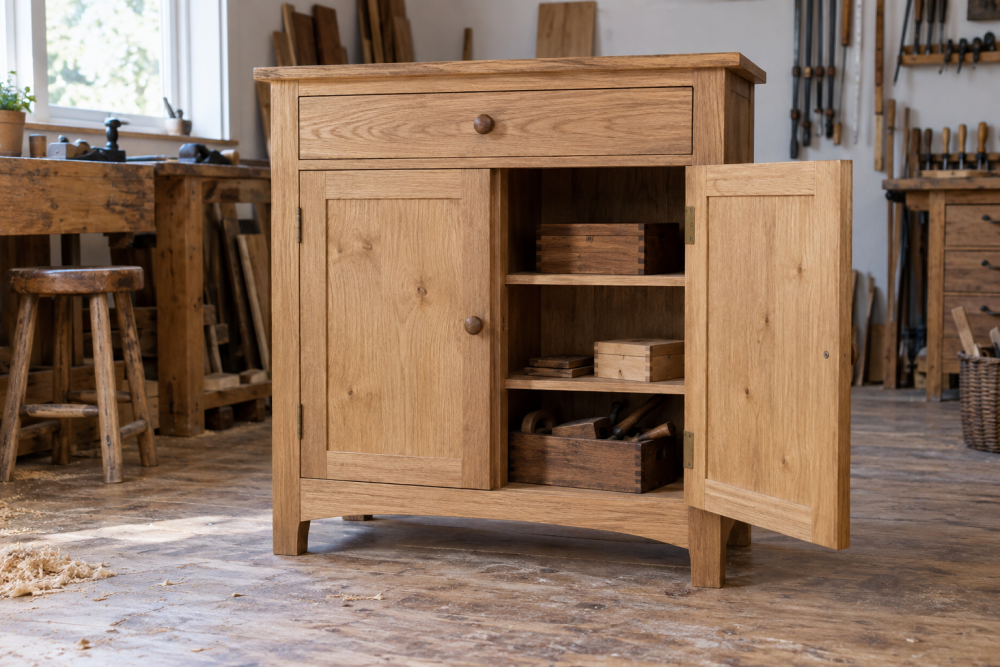
For a first wall-mounted tool cabinet, plywood is usually the easier, more predictable choice. It stays flatter than a wide solid-wood panel, comes in large sheets, and gives you a stable carcass without having to glue up boards. Solid wood still makes sense for face frames, doors, trim, or a cabinet built from boards you already have. The right choice depends on the cabinet’s size, the tools it will hold, and how you plan to hang it.
As an Amazon Associate we earn from qualifying purchases at no extra cost to you.



Contents
What the cabinet needs to handle
A wall cabinet carries more than its own weight. Add a few hand planes, clamps, or boxes of screws and the load can climb quickly. A 30-by-36-inch cabinet with a 3/4-inch plywood carcass may weigh 40 to 60 pounds before you load it; tools can add another 50 pounds or more. The wall attachment and cabinet back matter at least as much as the choice between plywood and solid wood.
For a beginner build, a practical starting point is a cabinet about 24 to 36 inches wide, 30 to 36 inches tall, and 10 to 12 inches deep. Use a 3/4-inch carcass for general storage, a 1/2-inch plywood back set into a rabbet or dado, and a solid cleat or French cleat secured to studs. Don’t count on drywall anchors alone for a loaded cabinet.
Plywood vs. solid wood
| Factor | Plywood | Solid wood |
|---|---|---|
| Movement | Cross-laminated layers help keep panels stable across seasons. | Expands and contracts across the grain as humidity changes. |
| Making large panels | One sheet gives you broad sides, top, and bottom without edge-gluing. | Wide panels need glued-up boards, careful grain matching, or a frame-and-panel design. |
| Edges and appearance | Edges show plies; cover them with iron-on veneer tape or solid edging. | Edges are solid wood and can be shaped or sanded easily. |
| Beginner risks | Cheap sheets may have voids, rough faces, or thin veneers that sand through. | Boards can cup, twist, split, or move enough to bind a door. |
| Cost and waste | Efficient for a cabinet layout, but good cabinet-grade sheets cost more than construction sheathing. | Can be economical if you have suitable offcuts; buying clear, dry boards may cost more. |
When plywood is the better buy
Choose 3/4-inch plywood for the sides, top, and bottom when you want a square, straightforward box. Cabinet-grade birch or maple plywood is a sensible option; inspect the sheet for flatness, damaged corners, and visible core gaps before buying. For a tool cabinet, a shop-grade face is usually adequate. A flawless furniture-grade surface is rarely worth paying extra for if the cabinet will live in a garage.
There is a cheaper route: sound 3/4-inch construction plywood can work for a painted cabinet if it is reasonably flat and its edges are covered. Expect rougher faces and more patching. Avoid sheets with loose veneer, big core voids near screw locations, or a pronounced bow. Plywood sold as 1/2 inch can vary in actual thickness, so measure it before cutting dados or setting a fence.
Plan the cuts to keep factory edges on visible fronts where possible. Use a sharp blade, support the sheet, and place the finished face so the saw’s most likely tear-out lands on the hidden side. A full sheet is awkward for one person to handle; ask the store to make rough cuts, or use a track saw or circular saw with a straightedge. A cabinet-grade plywood search can help you compare available sheet types and local pricing.
Where solid wood earns its keep
Solid wood is useful where a durable edge or a neat, furniture-like detail matters. A 1-by-2 face frame can hide plywood edges and stiffen the front. Solid edging around shelves protects corners from knocks. Solid wood also works well for a hanging cleat: use a straight, dry board, typically 3/4 to 1-1/2 inches thick, cut with a 45-degree bevel.
Building the entire cabinet from solid boards is possible, but it adds work. A 12-inch-wide side made from solid wood may move noticeably across its width through a humid summer and dry winter. If you fasten it rigidly across that movement, it can split, bow, or loosen joints. Narrow boards edge-glued into panels are more manageable, but still need joinery and seasonal movement allowances. For a first cabinet, reserve solid wood for parts that benefit from it instead of making every panel solid.
Build details that prevent failures
Cut both sides to matching dimensions and check the carcass for square by comparing its diagonals; they should be within about 1/8 inch before the back is fixed in place. Glue and screw or use dados for the top and bottom. A back set into a rabbet is stronger and easier to align than a thin panel simply tacked onto the rear. If using screws in plywood, predrill near edges and leave enough material to avoid splitting the veneer.
Keep heavy tools low and close to the wall. A 3/4-inch shelf spanning 30 inches may sag under a concentrated load, especially over time; add a front edging strip or a center divider if storing heavy items. Screw the cabinet cleat into at least two studs where the layout allows, and use fasteners long enough to pass through the cleat and wall finish and get solidly into the studs. Check for plumbing and wiring before drilling.
Seal or paint the cabinet, including the inside faces and exposed edges. Finish does not stop wood movement, but it reduces moisture exchange and makes plywood easier to clean. If you are painting, fill exposed plywood plies with edge banding or filler and sand lightly; aggressive sanding can cut through thin face veneer.
A practical shopping choice
For most beginners, buy one flat 3/4-inch plywood sheet for the carcass, a thinner plywood panel for the back, and a straight solid board for the hanging cleat and optional face frame. Choose an iron-on plywood edge-banding category if you want to cover visible plies without milling your own strips. If you have clean, dry boards already, solid wood can be the cheaper choice for trim and cleats. For the large cabinet panels, plywood is generally the simpler material to buy, cut, and keep square.